Most AML teams share the same queue problem. The transaction monitoring system fires, an analyst opens the alert, pulls the customer profile, scrolls through months of transactions, checks for adverse media, writes up why the activity is or is not suspicious, and closes it. Then they do it again. Most of those alerts lead nowhere, and the few that matter wait in the same line.
This is a good problem for AI, but only if you are precise about which part of the job you hand over. This guide is for founders, CTOs and compliance leads at fintechs, banks and payment companies who are being pitched "AI for AML" and want to know what to build, what to keep human, and what regulators actually say in late 2026.
Why alert triage is the right first target
Detection rules are deliberately broad because missing real laundering is expensive. The cost of that breadth is noise. A Columbia SIPA capstone prepared for Morgan Stanley's Global Financial Crimes Unit described most transaction monitoring systems as producing false-positive rates of "approximately 90%-95% on average". Vendors publish similar or higher numbers, usually alongside a claim that their product cuts them dramatically. Treat those as claims until you have tested them on your own data.
Even with that caveat, the shape of the work is clear. Most analyst time goes into gathering and summarising information, not into the judgement call at the end. That gathering is repetitive, rule-bound and well documented in your procedures, which is exactly what a language model with tool access does well.
There is also a clock. Under 31 CFR 1020.320, a US bank must file a suspicious activity report no later than 30 calendar days after initial detection of facts that may justify one. A backlog of unreviewed alerts is not just an efficiency problem; it is a deadline risk.
Prepare, recommend, decide: draw the line before you build
The most useful decision you can make early is to separate the work into three layers and assign each one explicitly.
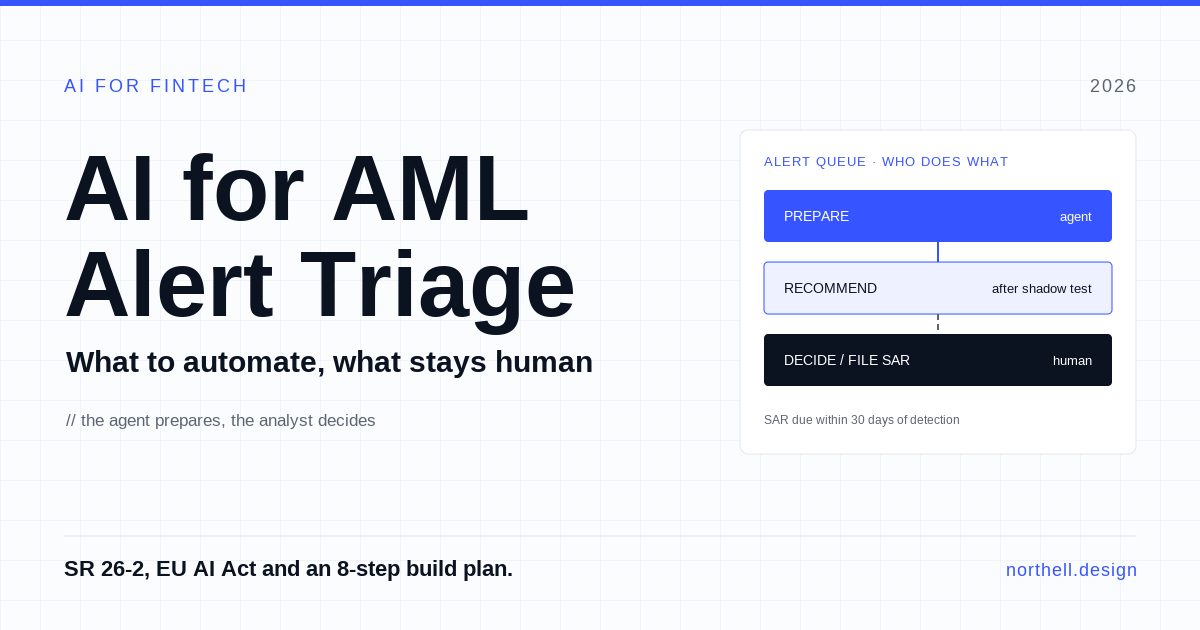
- Prepare: collect the evidence, summarise it and draft the narrative. Low risk, because a human reads everything before acting.
- Recommend: suggest a disposition (close, escalate, request more information) with reasons. Medium risk, because people anchor on suggestions.
- Decide: close the alert, open a case, file a SAR, exit the customer. High risk, because these are the decisions examiners and courts look at.
Our opinion: start with "prepare" only. Add "recommend" after a shadow period proves the agent agrees with your best analysts on a defined alert type. Keep "decide" with people unless you have a narrow, measured, documented reason to do otherwise. Most of the time savings sit in the preparation layer anyway, so you give up little by being conservative.
| Task | AI role | Human role | Main risk if AI gets it wrong |
|---|---|---|---|
| Pull customer profile, KYC data and account history | Do it (read-only tools) | Spot-check sources | Wrong customer or stale data in the file |
| Summarise transaction patterns for the alert window | Do it, with links back to each transaction | Verify totals and outliers | Miscounted amounts or invented patterns |
| Screen names against adverse media | Search and summarise hits | Judge relevance of matches | False matches on common names |
| Draft the alert narrative | Draft in your house format | Edit and sign off | Confident narrative built on a wrong fact |
| Suggest a disposition | Only after shadow testing | Make the call | Analysts rubber-stamp a bad suggestion |
| Close alert, file SAR, exit customer | No | Own the decision | Regulatory breach, missed reporting |
What regulators have said, and what they have not
Regulators are not against this. On December 3, 2018, FinCEN and the federal banking agencies issued a joint statement encouraging institutions to "consider, evaluate, and, where appropriate, responsibly implement innovative approaches" to BSA/AML compliance. The FDIC chair at the time said AI and machine learning could help banks of all sizes manage money-laundering risk while reducing the cost of compliance.
The bigger 2026 change is in model risk management. On April 17, 2026 the Federal Reserve, OCC and FDIC issued SR 26-2, Revised Guidance on Model Risk Management. It supersedes SR 11-7 and SR 21-8, the 2021 interagency statement on model risk for BSA/AML systems. Three points in it matter for an AML agent:
- It emphasises a risk-based approach tailored to the institution's model risk profile, size and complexity.
- It excludes deterministic rule-based processes with no statistical theory behind them from the definition of a model. Many classic monitoring rules may therefore fall outside it.
- It states plainly that "generative AI and agentic AI models are novel and rapidly evolving. As such, they are not within the scope of this guidance."
Some vendors will read point three as "no rules apply". That is the wrong reading. It means there is no tailored supervisory template for your LLM agent, so the burden shifts to you to show it is controlled. Your BSA/AML program obligations, third-party risk management and the basic expectation that you can explain your decisions all still apply. If anything, a well-documented validation and monitoring approach is more valuable when there is no checklist to point at.
If you operate in the EU
Two dates matter. The EU Anti-Money Laundering Regulation, Regulation (EU) 2024/1624, applies from 10 July 2027, replacing much of the national patchwork with one rulebook. Separately, the AI Act's Annex III lists credit scoring of individuals as high-risk, with an exception for systems whose main purpose is fraud detection. According to McCann FitzGerald's summary of the Commission's draft guidelines, AML and counter-terrorist financing systems are not covered by that fraud exception, and Annex III obligations have been postponed to 2 December 2027. The guidelines were still in draft at the time of that summary, so check the final text and take legal advice if your AML tooling also influences credit decisions.
Working on something like this? See our Claude Agent Development →
What AI will not fix: the TD Bank lesson
It is tempting to treat an AI agent as a fix for a weak AML program. It is not. In October 2024 TD Bank pleaded guilty and agreed to pay over $1.8 billion in penalties. The Justice Department said the bank did not automatically monitor all domestic ACH transactions or most check activity, leaving 92% of total transaction volume unmonitored between January 2018 and April 2024, and that it made no material changes to its monitoring scenarios from at least 2014 through late 2022.
No triage agent would have caught activity that never generated an alert. Triage AI makes your review of alerts faster and more consistent. Coverage, scenario design and tuning are separate work, and they come first. If your scenarios have not been reviewed since you launched a new product line, fix that before you spend money on an agent.
An 8-step plan for an alert-triage agent
- Map your alert mix. List alert types by volume, average handling time and historical escalation rate. Pick one or two high-volume, low-escalation types for the pilot. Simple, repetitive retail alert types are better candidates than complex trade finance cases.
- Write down the boundary. Use the prepare/recommend/decide split above and get compliance leadership to sign it. This document becomes part of your governance pack.
- Give the agent read-only tools. Build narrow tools that fetch customer data, transactions in the alert window, prior alerts and screening results. No write access to case management in phase one. Every tool call is logged with inputs and outputs.
- Make every claim traceable. The narrative should cite the transaction IDs, documents and screening hits it relies on, and the reviewer UI should open them in one click. A summary an analyst cannot verify quickly will either be ignored or trusted blindly, and both are bad.
- Build the evaluation set first. Take a few hundred historical alerts of the chosen types with known dispositions and good narratives. Define what "correct" means: facts accurate, relevant patterns mentioned, disposition matching the analyst. Run every prompt or model change against this set.
- Run in shadow mode. The agent prepares files for live alerts but analysts work as usual. Compare its drafts and suggested dispositions to theirs. Pay most attention to cases the analyst escalated and the agent would have closed; those are the misses that matter.
- Launch preparation, measure overrides. Turn on agent-prepared files for analysts. Track handling time, how often analysts change the narrative materially, and how often they disagree with any suggestion. A falling override rate can mean the agent is improving or that people stopped checking, so sample and re-review a share of closed alerts.
- Version and monitor. Pin model versions, keep prompt and tool changes under change control, and re-run the evaluation set before every change and on a schedule. When the model provider retires a model, treat the replacement as a new model to validate.
Designing for the analyst, not the demo
Most AML AI demos show a chatbot answering questions about a customer. Analysts do not want to chat; they want a case file that is mostly assembled, in the layout they already know. The design work that matters is unglamorous: showing confidence and gaps honestly, flagging which facts came from which system, making disagreement fast to record, and never hiding the raw data behind the summary. We cover these patterns in more depth in our guide on how to design UX for AI features users trust.
Two details are easy to miss. First, store the agent's draft and the analyst's final version side by side. That diff is your best quality signal and your audit trail. Second, show the analyst what the agent did not check. "No adverse media search was run because the screening service timed out" is far more useful than a clean summary that silently skipped a step.
Build, buy or extend
The choice usually comes down to where your data lives and how standard your workflow is.
| Situation | Sensible route | Why |
|---|---|---|
| Your monitoring vendor offers triage features covering your main alert types | Buy, then validate on your own history | Fastest path; integration already exists |
| Custom case management or an in-house monitoring stack | Build a narrow agent on your own tools | Vendors cannot reach your internal context |
| Vendor monitoring, but key context sits in internal systems | Extend: vendor alerts plus your own preparation agent | Keeps detection with the vendor, adds the context only you have |
| Scenario coverage is known to be weak | Neither yet | Fix detection first; triage cannot review alerts that never fire |
If you build, keep the architecture boring. One agent with a handful of well-defined tools is easier to validate and explain than a team of agents passing work between them. We explain where that line sits in single agent vs multi-agent systems.
Red flags in an AML AI pitch
- The headline metric is a false-positive reduction percentage with no description of how it was measured or on whose data.
- The product closes alerts automatically by default.
- Narratives do not cite the underlying transactions or documents.
- The vendor cannot tell you which model is used, how model changes are communicated, or how you can re-test after an update.
- The pitch says the tool is "SR 11-7 compliant". That guidance was superseded in April 2026, and the replacement puts generative and agentic AI outside its scope.
- No answer on data residency, retention of prompts and outputs, or whether your data is used to train the vendor's models.
How Northell can help
We build fintech products and AI features, and AML tooling sits where both meet. Our usual starting point is mapping your alert mix and data sources, then designing the analyst experience and building a narrow, read-only preparation agent with an evaluation set your compliance team can inspect. You can see more about our work in fintech software development and AI for fintech. If your analysts are drowning in alerts and you want a second opinion on where AI fits, get in touch with a short description of your alert volumes and current tooling.