Almost every AI project we scope reaches the same fork early: should the model be fine-tuned on the company's data, or should it look things up at answer time? Founders often arrive assuming fine-tuning is the serious, grown-up option and retrieval is the shortcut. For most products it is the other way round.
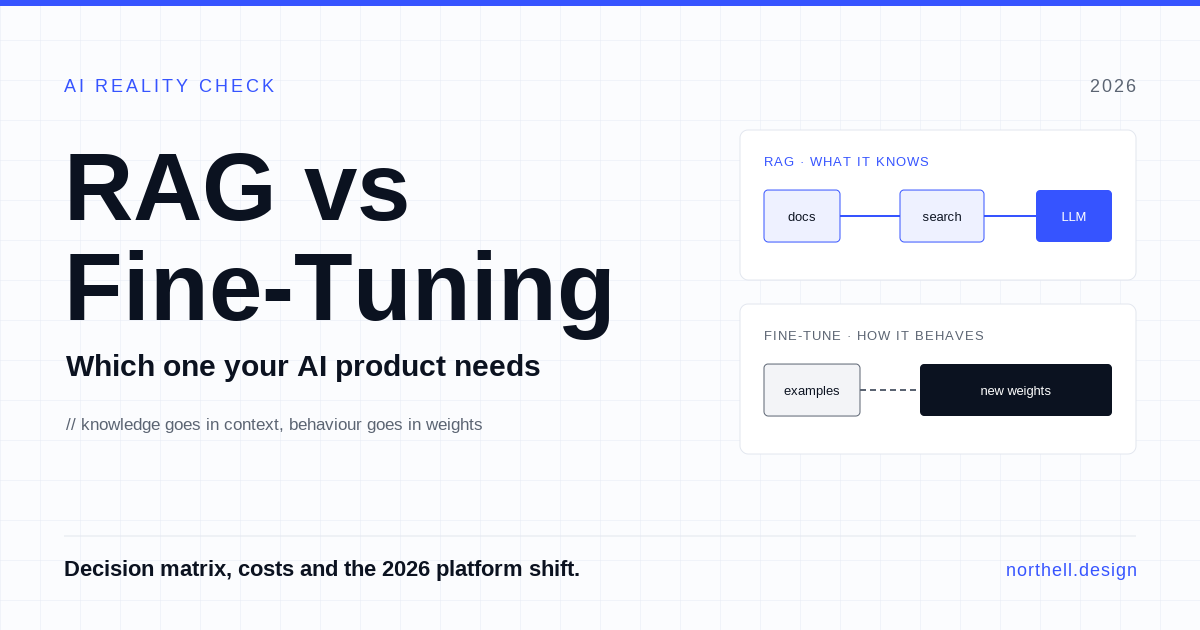
The short version: retrieval-augmented generation (RAG) changes what a model can see; fine-tuning changes how it behaves. If your problem is that the model does not know your policies, your product catalogue or your customer's account history, that is a knowledge problem, and knowledge belongs in context. If your problem is that the model will not consistently output your 14-category label scheme or your exact JSON shape, that is a behaviour problem, and fine-tuning may help. This article explains how to tell which one you have, what each really costs in 2026, and why the market has shifted further toward retrieval this year.
What each approach actually does
RAG keeps the model as it is. When a user asks a question, your system searches a store of documents (help articles, contracts, tickets, database rows), picks the most relevant passages and places them in the prompt alongside the question. The model answers using that material. Update a document and the next answer reflects it. Because you know which passages were retrieved, you can show citations and enforce permissions: a user only gets passages they are allowed to see.
Fine-tuning trains a copy of the model on example inputs and the outputs you want. The result is a model whose default habits have shifted. OpenAI's own documentation lists the tasks supervised fine-tuning is best for as classification, nuanced translation, generating content in a specific format and correcting instruction-following failures (OpenAI, model optimization guide). Notice what is missing from that list: teaching the model facts about your business.
That omission matters. A tuned model may absorb some recurring facts from its training examples, but it cannot tell you where an answer came from, it does not know anything that changed after training, and it can still be confidently wrong. For a support assistant, an internal knowledge tool or anything in a regulated domain, those are the properties buyers care about most.
The option most teams skip: just put it in the prompt
Before choosing between RAG and fine-tuning, measure how much material you actually have. Anthropic's guidance is blunt: if your knowledge base is smaller than 200,000 tokens, about 500 pages, you can include the entire thing in the prompt with no need for RAG (Anthropic, Contextual Retrieval).
Plenty of first versions fit inside that limit: a product's help centre, a policy handbook, a pricing sheet and a set of example answers. Paired with prompt caching, where the provider bills repeated prompt prefixes at a fraction of the normal input price, this is often the fastest and cheapest way to ship. We covered how caching changes the maths in our guide on how to reduce LLM API costs.
It stops working when the material grows past the window, when different users must see different documents, or when you need to cite sources precisely. That is when retrieval earns its complexity.
The 2026 shift: hosted fine-tuning got riskier
This year changed the calculation for anyone planning to fine-tune a commercial model. OpenAI's documentation now states that it is winding down its fine-tuning platform: it is no longer accessible to new users, existing users can create training jobs "for the coming months", and fine-tuned models remain available for inference only until their base models are deprecated (OpenAI, model optimization guide). OpenAI's pricing page already marks the GPT-4.1 fine-tuning models as deprecated (OpenAI pricing).
Fine-tuning has not disappeared from the market. Google's Vertex AI documentation still lists supervised fine-tuning for several Gemini models, including Gemini 3.5 Flash and Gemini 2.5 Pro, and describes it as a good option "when you have a well-defined task with available labeled data" (Google Cloud, supervised fine-tuning for Gemini). Open-weight models can be tuned on your own infrastructure with parameter-efficient methods such as LoRA, which its authors reported reduced trainable parameters by 10,000 times and GPU memory needs by three times compared with full fine-tuning of GPT-3 175B (Hu et al., LoRA).
The lesson for buyers is not "fine-tuning is dead". It is that a tuned model is tied to one provider's base model and roadmap. When that base model is retired, your tuned version goes with it, and you pay for data preparation, training and evaluation again. A RAG system is far more portable: the index, the retrieval logic and the evaluation set stay put while you swap the model underneath.
Working on something like this? See our Claude Agent Development →
Decision matrix: which problem do you actually have?
Use the table below with a specific failure in mind, not a general wish for the model to be "smarter about our business".
| What goes wrong today | Problem type | Start with | Consider fine-tuning when |
|---|---|---|---|
| Answers ignore or invent your policies, prices or product details | Knowledge | Prompt with the full material if it fits, otherwise RAG | Almost never for this |
| Answers are out of date after content changes | Knowledge freshness | RAG with re-indexing on update | Never; retraining is the slow path |
| Users must only see documents they have access to | Permissions | RAG with permission filters on retrieval | Never; tuned weights cannot enforce access rules |
| Answers need citations users can check | Traceability | RAG | Never on its own |
| Model will not follow your label scheme or output format consistently | Behaviour | Structured outputs, few-shot examples | Prompting plateaus and you have hundreds of labelled examples |
| Tone or style drifts from your brand voice | Behaviour | Style guide and examples in the system prompt | High volume, and reviewers can reliably judge good vs bad output |
| A large model works but is too slow or costly at your volume | Cost and latency | Caching, routing, shorter prompts | A narrow, stable task you can move to a smaller tuned model |
In our experience the first four rows describe most of what buyers bring to an AI feature. The last three are real, but they usually appear after launch, once you have traffic, failure data and examples to learn from.
What each one really costs
Compute prices are the part everyone asks about and the part that matters least. Here is a rough comparison using published list prices where they exist.
A managed RAG example
OpenAI's hosted file search tool is a useful reference point because the price is public: storage costs $0.10 per GB per day with the first GB free, and tool calls cost $2.50 per 1,000 calls (OpenAI pricing). Say you index 5 GB of documents and your product makes 100,000 searches a month. Storage works out at 4 billable GB × $0.10 × 30 days = $12 a month. Searches cost 100 × $2.50 = $250 a month. On top of that you pay for the model tokens, including the retrieved passages added to each prompt, which at volume is usually the larger line item.
A custom RAG pipeline on your own database and search stack trades those per-call fees for engineering time: chunking, embeddings, hybrid search, permission filtering, re-indexing jobs and monitoring. That is typically worth it when you need fine-grained permissions, data residency, or retrieval quality you can tune.
A fine-tuning example
On OpenAI's price list, training gpt-4.1 cost $25 per million training tokens, and the tuned model was billed at $3 per million input tokens and $12 per million output tokens (OpenAI pricing). Take 2,000 examples of about 1,500 tokens each, trained for three passes: 9 million training tokens, or about $225 per training run. That is cheap. What is not cheap:
- Building the dataset. Hundreds or thousands of correct, reviewed examples. If your team has to write or label them, this is weeks of expert time.
- Evaluation. Every training run needs to be compared against the untuned baseline on a held-out test set, or you are guessing.
- Re-tuning. When the base model is retired, or a better one ships, the whole cycle repeats. Given OpenAI's wind-down, that is no longer hypothetical.
| Cost driver | Prompt-only | RAG | Fine-tuning |
|---|---|---|---|
| Upfront build | Lowest | Medium: ingestion, chunking, search, permissions | Medium to high: dataset creation and labelling |
| Cost per request | High prompt tokens, offset by caching | Search fees plus retrieved tokens | Can be lowest with a small tuned model and short prompts |
| Updating knowledge | Edit the prompt | Re-index changed documents | Retrain, re-evaluate, redeploy |
| Switching model provider | Easy | Easy: the index stays | Hard: start the tuning over |
| Main risk | Outgrowing the context window | Poor retrieval quality | Base model deprecation and dataset drift |
RAG has failure modes too, and they are fixable
The honest objection to RAG is that it often works badly in its first version. The model answers from the wrong passage, or the right passage is never retrieved because the chunk lost its context when the document was split. A chunk that says "revenue grew 3% over the previous quarter" is useless if it no longer says which company and which quarter.
These are engineering problems with known fixes. Anthropic's contextual retrieval technique prepends a short, model-generated description of each chunk's context before indexing it. In Anthropic's tests, contextual embeddings alone reduced the top-20 retrieval failure rate by 35%, adding contextual BM25 keyword search took that to 49%, and adding a reranking step took it to 67%, from 5.7% to 1.9% (Anthropic, Contextual Retrieval). Those are vendor benchmark results on vendor-chosen datasets, so treat them as direction rather than a guarantee for your data. The point stands: when RAG underperforms, the fix is usually better retrieval, not a different architecture.
The usual culprits, in the order we check them:
- Source quality. Duplicate, outdated or contradictory documents in the index. No model fixes this.
- Chunking. Chunks too small to carry meaning, or too large to rank well.
- Search type. Pure vector search misses exact terms like product codes and policy numbers. Hybrid search with keyword matching catches them.
- Ranking. A reranker re-orders the candidates before they reach the prompt.
- Prompting. The model is not told to say "I don't know" when retrieved passages do not answer the question.
When fine-tuning genuinely earns its place
We are not against fine-tuning. It is the right tool in a few situations, and they share a pattern: a narrow task, high volume, a stable definition of a correct answer, and a supply of good examples.
- High-volume classification. Routing support tickets, tagging transactions, triaging documents into a fixed scheme. A small tuned model can be faster and cheaper per call than a large general model with a long prompt.
- Strict output formats that structured outputs and examples still get wrong too often for your tolerance.
- Distilling a large model into a small one. OpenAI's guide lists training "a smaller, cheaper, faster model to excel at a particular task" as one of the benefits (OpenAI, model optimization guide).
- Data that cannot leave your infrastructure, where you are already running an open-weight model and tuning it with LoRA on your own hardware.
Even then, fine-tuning and RAG are not rivals. A tuned model that knows your output format can still receive retrieved documents in its prompt. Knowledge in context, behaviour in weights.
How to decide in practice: a six-step sequence
- Write down the failure. One sentence per problem, with three real examples. "The assistant quotes last year's refund policy" is useful. "It should understand our business better" is not.
- Build an evaluation set. 50 to 200 real questions with known good answers, reviewed by someone who knows the domain. This is the asset that outlives every model choice.
- Measure your knowledge base. If it fits in the context window and every user may see all of it, start with prompt plus caching.
- If it does not fit, build RAG. Start with hybrid search and permission filters, then add reranking or contextual chunking if the evaluation set shows retrieval misses.
- Only then look at behaviour gaps. If a specific format or classification still fails after better prompts and structured outputs, collect the failing cases. Those become your fine-tuning dataset.
- Choose a tuning route you can maintain. Check the provider's deprecation policy, plan for re-tuning, and keep the untuned baseline running so you can compare.
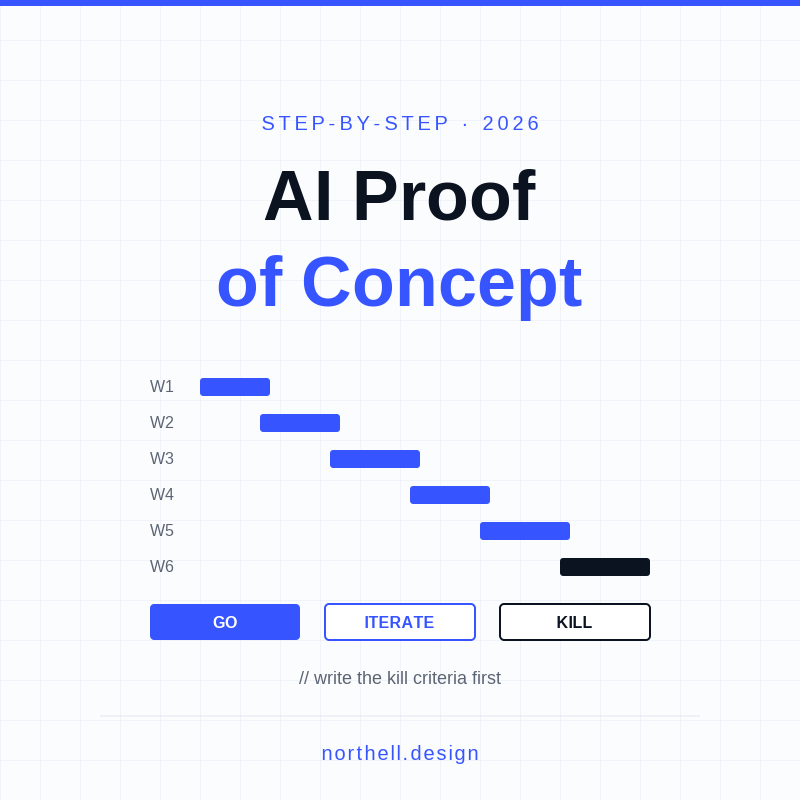
This is the same discipline we recommend for any AI pilot: define success before building, as covered in our guide on how to scope an AI proof of concept.
Red flags in a vendor proposal
- Fine-tuning is proposed before anyone has measured whether the knowledge base fits in a prompt.
- The pitch says fine-tuning will make the model "know" your company, with no mention of citations or freshness.
- There is no evaluation set, or it will be built "after training".
- Nobody can say which base model will be tuned or what happens when it is retired.
- The RAG plan has no permission model, even though different users should see different documents.
Where Northell fits
We design and build AI features as product work: starting from the user and the failure that matters, building the evaluation set, and choosing the simplest architecture that passes it. Most of the time that means good prompts and retrieval first, with fine-tuning held back until data shows it is needed. If you are weighing these options for a product or internal tool, our AI development team can review your use case and data, or you can get in touch with a short description of what the model is getting wrong today.