Building a mobile app has never been easier to start or harder to get right. Cross-platform frameworks have matured, AI tools speed up routine code, and a working prototype can appear in days. Yet most apps still fail on the parts that tools do not solve: a product that nobody returns to, an onboarding flow that loses half its users, a release process that breaks with every OS update.
The companies on this list are the ones we would shortlist in 2026 for building apps that last. They are product studios rather than code factories: design, engineering and post-launch iteration in one team.
How We Chose the 12
- Shipped work: apps in the stores, for recognisable clients, that you can download and judge yourself.
- Product capability: design, research and engineering in the same team.
- Technical range: native iOS and Android plus at least one cross-platform framework.
- Longevity and continuity: years operating, team stability and ownership.
- Verifiability: what can be confirmed from public portfolios and references.
The list is grouped by region because time zone, rates and working style differ by region more than by any other single factor. Order within each region is editorial.
United States
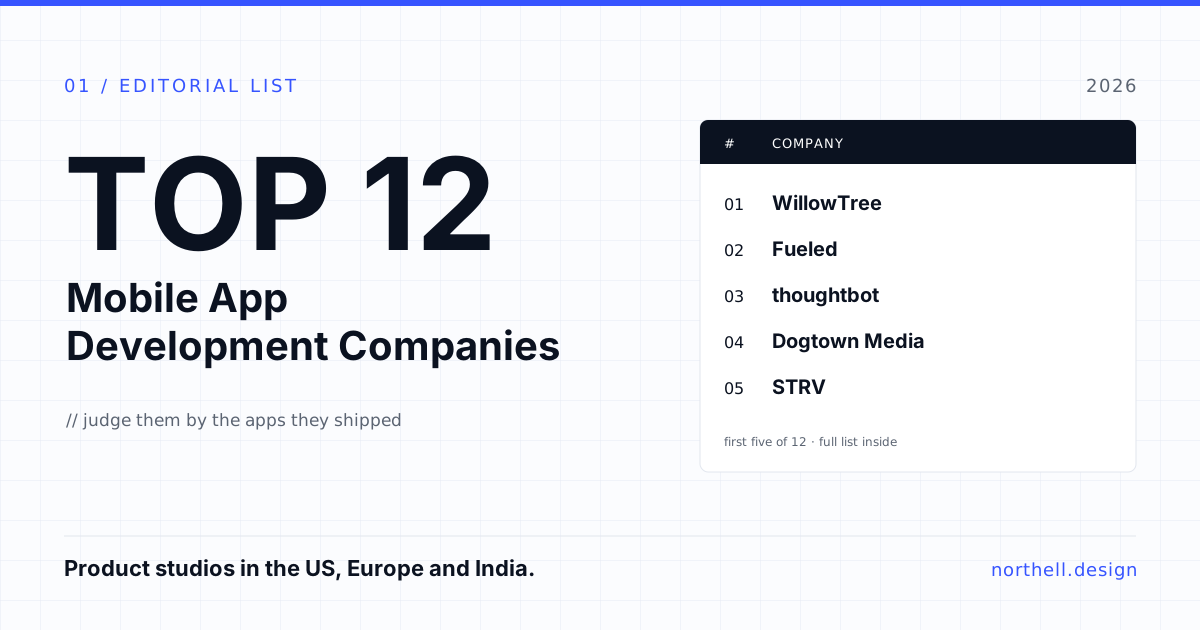
1. WillowTree (a TELUS Digital company)
Charlottesville, Virginia-based WillowTree is one of the best-known US digital product studios, building apps for large consumer brands across media, retail, healthcare and financial services. TELUS International acquired it in January 2023 for $1.225 billion including debt, which gives it larger-group backing.
Best for: large consumer brands that need flagship apps built and run at scale.
2. Fueled
New York-based Fueled is a design-led app studio known for polished consumer apps and work for well-known brands, with product strategy and growth services around the build.
Best for: consumer brands and funded startups where design quality is the priority.
3. thoughtbot
thoughtbot is a long-established product design and development consultancy known for its open-source contributions and teaching culture. It works closely with client teams and is a good choice when you want to learn good product practice while building.
Best for: startups that want to build product and engineering capability alongside the app.
4. Dogtown Media
Los Angeles-based Dogtown Media builds iOS and Android apps with a notable focus on healthcare, wellness and IoT-connected products.
Best for: health, wellness and connected-device apps.
Europe
5. STRV
Founded in Prague in 2004 and working with US and European clients, STRV is a design and engineering team of more than 200 people that has built for companies including Porsche, Microsoft, ClassDojo and The Athletic. It works as an extended team, combining product, design and engineering.
Best for: US and European scale-ups that want a senior product team at European rates.
6. Infinum
Zagreb-based Infinum is one of the largest design and engineering agencies in Central Europe, building mobile and web products for banking, healthcare and media clients, with a strong engineering culture and a sizeable open-source footprint.
Best for: banks and enterprises that need secure, well-engineered mobile apps.
7. Netguru
Poznań-based Netguru offers product design, mobile and web engineering, and AI work, with a large team and a long record with startups and enterprises across Europe and the US.
Best for: companies that need a large European team for product builds and scale-up work.
8. Miquido
Kraków-based Miquido builds mobile apps, with notable experience in fintech, entertainment and health, and strong Flutter capability alongside native development.
Best for: fintech and consumer apps where Flutter is a good fit.
9. Droids On Roids
Wrocław-based Droids On Roids is a mobile-first studio with deep Flutter and native experience, known for consumer and commerce apps and a transparent, process-driven way of working.
Best for: commerce and consumer apps built with Flutter or native.
10. Monterail
Wrocław-based Monterail combines web and mobile development, with strong React Native and Vue.js expertise, which suits products that share logic and design across web and mobile.
Best for: products that need consistent web and mobile experiences on a JavaScript stack.
11. Hedgehog Lab
Newcastle-based Hedgehog Lab began as a web agency in 2007 and moved to multi-platform software in 2011, with offices in the UK, US and Bulgaria. Clients have included Santander, Deliveroo and Microsoft.
Best for: UK enterprises and scale-ups that want a local product partner.
Working on something like this? See our Hire a Dedicated Developer →
India
12. Appinventiv
Noida-based Appinventiv is a large mobile and software development company with a broad portfolio across retail, fintech, healthcare and on-demand apps, offering scale and pricing that European and US studios rarely match.
Best for: budget-conscious projects with clear requirements that need a large team.
At a Glance
| # | Company | HQ | Strongest fit |
|---|---|---|---|
| 1 | WillowTree | Charlottesville, USA | Flagship consumer brand apps |
| 2 | Fueled | New York, USA | Design-led consumer apps |
| 3 | thoughtbot | USA | Building product capability |
| 4 | Dogtown Media | Los Angeles, USA | Health and IoT apps |
| 5 | STRV | Prague, Czechia | Senior product teams |
| 6 | Infinum | Zagreb, Croatia | Secure enterprise apps |
| 7 | Netguru | Poznań, Poland | Large-team product builds |
| 8 | Miquido | Kraków, Poland | Fintech and Flutter apps |
| 9 | Droids On Roids | Wrocław, Poland | Commerce and consumer apps |
| 10 | Monterail | Wrocław, Poland | Web plus mobile on JavaScript |
| 11 | Hedgehog Lab | Newcastle, UK | UK product partner |
| 12 | Appinventiv | Noida, India | Scale at lower cost |
What Is Changing in Mobile Development
Cross-platform grew up. React Native made its New Architecture the default in version 0.76, Flutter is mature across mobile, web and desktop, and Kotlin Multiplatform is stable for sharing business logic. The question is no longer whether cross-platform works but which approach fits your product.
Distribution rules diverged. In the EU, the Digital Markets Act opened iOS to alternative app marketplaces and payment options, while other markets kept the traditional model. Google Play now requires new personal developer accounts to run a closed test before production release. Recent shipping experience in your markets matters.
AI moved into apps. On-device models, AI assistants and smarter search are becoming standard features. Ask how a vendor handles model costs, latency, privacy and offline behaviour, not only whether it can call an API.
Retention became the metric. With acquisition costs high, the studios that stand out are those that design for activation and retention and keep iterating after launch.
How to Vet a Mobile App Development Company
- Which of your apps can I download today? Use them before the call.
- Native or cross-platform for my app, and why? A good team will argue from your requirements, not its preferences.
- Who on the team will design, and who will build? Meet them.
- What is your testing and release process? Automated tests, beta distribution, staged rollouts and crash monitoring.
- What happens after launch? Analytics, iteration and maintenance, and how they are priced.
- Will store accounts, signing keys and code be ours? The answer must be yes.
For more on the build, see our mobile app development service, our guide to outsourcing mobile app development, and our Flutter and React Native pages. If you are still estimating, our mobile app design cost guide helps with the design side of the budget.
The Bottom Line
The best mobile app development company is the one that will still be improving your app a year after launch. In the US, WillowTree, Fueled, thoughtbot and Dogtown Media lead for different kinds of product. In Europe, STRV, Infinum, Netguru, Miquido, Droids On Roids, Monterail and Hedgehog Lab offer senior product teams at mid-range rates. In India, Appinventiv offers scale. Shortlist by product type, budget and time zone, then use the apps they have shipped before you believe anything else.
If you are planning an app and want an honest view on scope, platform and partner fit, tell us what you are building.
Independent editorial list by the Northell editorial team. No company paid for inclusion, and Northell is not included. Company facts reflect public information available at the time of writing; confirm current capabilities, teams and pricing directly with each company before contracting.