Shipping runs on software that most people never see: planned maintenance systems on board, voyage optimisation in the operations room, chartering platforms on the commercial desk, terminal operating systems at the quay. In 2026 that stack is under more pressure than at any point in the last decade, because carbon regulation turned voyage and fuel data from an operational nice-to-have into a cost line. Under the EU Emissions Trading System, shipping companies surrender allowances for 100% of their covered emissions from the 2026 reporting year, up from 40% for 2024 and 70% for 2025.
That is why "maritime software development company" is a more confusing search than it looks. It returns two very different kinds of business. Some build licensed platforms for the whole industry. Others build custom software for one owner, operator or port. This guide covers both, explains which job each is good for, and gives you the questions to ask before you sign.
Platform or Custom Build: The Decision That Comes First
Before comparing vendors, decide which kind you need for each workflow. Getting this wrong is the most common and most expensive mistake we see in maritime technology projects.
| Workflow | Usually best served by | Why |
|---|---|---|
| Planned maintenance, safety management, crewing | Platform | Standardised, audited by class and flag, compliance updates shared across fleets |
| Chartering, voyage P&L, freight and demurrage | Platform | Mature products with industry-standard data models |
| Voyage, fuel and emissions optimisation | Platform, often with custom integration | Models need large fleet datasets; your data still needs a clean pipeline in |
| Terminal operations | Platform | TOS products run hundreds of ports; building one is rarely justified |
| Integrations between systems, owner dashboards, customer portals | Custom build | Specific to your stack, your clients and your reporting |
| Internal tools for workflows unique to your business | Custom build | No vendor will prioritise them |
Most fleets end up with a licensed core and a thin custom layer on top. That is a good outcome, as long as the custom layer is designed to survive vendor upgrades.
How We Built This List
We looked at companies that either sell software built specifically for maritime operations or offer custom development with shipped maritime work they describe publicly. We weighed five things:
- Maritime depth. Does the product or team speak the domain (voyages, charters, class, flag, terminals), or is shipping one logo among fifty?
- Operational fit. Behaviour with intermittent satellite links, offline use on board, and integration with the systems fleets already run.
- Regulatory readiness. Support for CII, EU MRV and ETS, FuelEU Maritime, and IACS cyber rules where relevant.
- Scale and staying power. Installed base, ownership, and how recent consolidation affects the roadmap.
- Transparency. How much of the above can be checked from public information rather than sales claims.
The list is in two groups because comparing a classification society's software arm with a 50-person custom development shop on one scale would be meaningless. Order within each group reflects breadth and evidence, not a precise score.
Maritime Software Platforms
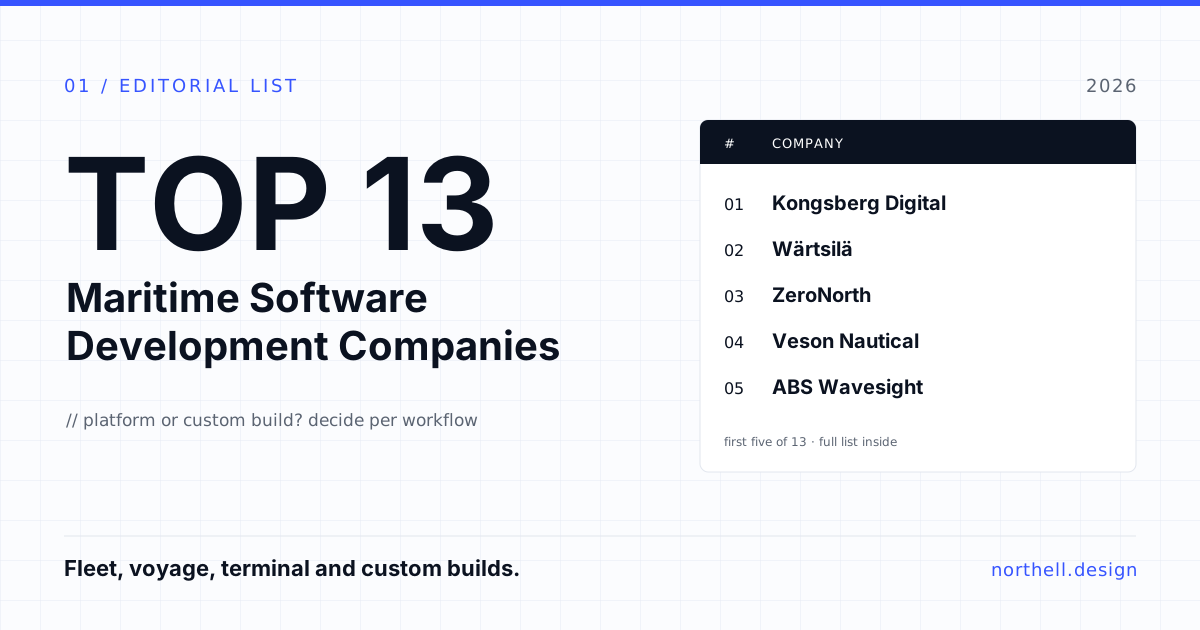
1. Kongsberg Digital
Kongsberg Digital is the software arm of Norway's Kongsberg group, and it covers more of the vessel data problem than almost anyone. Vessel Insight is its vessel-to-cloud data infrastructure, Kognitwin is its digital twin product, and the K-Sim range is one of the most widely used maritime simulator families for training. The breadth is the point: if you want one partner for data collection on board, a cloud data layer and simulation, few others can offer it.
Best for: owners and operators building a long-term vessel data foundation, and training centres.
2. Wärtsilä
Wärtsilä's software reach comes largely from Transas, which it acquired in 2018, adding navigation, simulation and fleet operations products to its engine and propulsion business. The Voyage division was folded into Wärtsilä's marine business from 2023, so software now sits closer to the hardware. That integration is the strength for fleets already running Wärtsilä equipment, and the question to ask if you are not.
Best for: fleets with Wärtsilä machinery or bridge systems that want connected performance and voyage tools.
3. ZeroNorth
ZeroNorth started inside Maersk Tankers and became one of the main independent voyage, fuel and emissions optimisation platforms. Its merger with Singapore-based Alpha Ori Technologies, which received regulatory approval in February 2024, added onboard data and sensor capability; coverage of the deal put the combined fleet served at more than 4,000 vessels, with operations led from Copenhagen. Its pitch maps directly onto the commercial pain of CII and EU ETS.
Best for: tanker and bulk operators that need voyage optimisation and emissions reporting tied to commercial decisions.
4. Veson Nautical
Boston-based Veson Nautical makes IMOS, the commercial and chartering platform that a large share of the dry bulk and tanker markets use for voyage estimates, P&L, freight, laytime and demurrage. If your commercial desk still lives in spreadsheets, Veson is the default benchmark you will be compared against, even if you pick something else.
Best for: commercial teams at owners, operators and charterers that need an industry-standard voyage management system.
5. ABS Wavesight
The classification society ABS launched ABS Wavesight in late 2022 as a dedicated software company, combining its Nautical Systems fleet management suite with My Digital Fleet. At launch the two platforms were installed on more than 5,000 vessels. Nautical Systems covers maintenance, purchasing, safety and compliance, and a web-based version has followed the original desktop product.
Best for: technical managers who want an established fleet management suite with deep compliance coverage.
6. DNV
DNV, the Norwegian classification and assurance group, runs Veracity, its industry data platform, alongside maritime software for ship design, risk and fleet compliance. Its value is trust: data verified or exchanged through a class society carries weight with regulators, charterers and financiers in a way that a startup's dashboard does not.
Best for: owners that need verified data exchange for emissions reporting, financing or charterer requirements.
7. NAPA
Helsinki-based NAPA is best known for ship design and stability software used by shipyards and designers worldwide, and for onboard loading and stability tools. It has extended that physics expertise into fleet intelligence and voyage optimisation, which gives its performance models an engineering grounding that pure analytics companies have to build from data alone.
Best for: shipyards, naval architects, and operators that want performance tools built on hydrodynamic models.
8. Kaleris (Navis)
Kaleris owns Navis, whose N4 terminal operating system runs in more than 500 ports worldwide according to the company. For container terminals, this is the reference product. Recent go-lives such as Port of Tanjung Pelepas upgrading to its latest N4 release show the installed base still investing.
Best for: container terminal operators selecting or upgrading a TOS.
9. Hanseaticsoft (Lloyd's Register)
Hamburg-based Hanseaticsoft built Cloud Fleet Manager, a cloud-first fleet management suite, and was acquired by Lloyd's Register in 2018. It was one of the earlier products to assume cloud and browser access from the start, which tends to show in usability for shore teams.
Best for: small and mid-sized managers that want a modern, cloud-first fleet management system.
10. Orca AI
Orca AI applies computer vision and sensor fusion to navigation, detecting and classifying targets around the vessel and alerting the bridge team. It is one of the clearest examples of AI in shipping doing a specific, measurable job, close-quarters situations and collision risk, rather than a vague optimisation promise.
Best for: operators that want to improve navigational safety and collect data on close encounters across the fleet.
11. Kpler
Kpler is a trade and commodity intelligence company, and its April 2025 acquisition of Spire Maritime, for about $241 million, added satellite AIS vessel tracking to its cargo-flow data. For development teams, Kpler matters as a data source: many custom maritime applications need reliable vessel positions and cargo context, and buying that feed is almost always cheaper than assembling it.
Best for: traders, charterers and analytics teams, and anyone building custom tools that need vessel tracking data.
Working on something like this? See our Hire a Dedicated Developer →
Custom Maritime Software Development Partners
This group is younger and smaller, and much of what is public is the companies' own positioning. Treat the claims below as claims, and check them with references.
12. Sea (Setapp)
Sea, the freight chartering marketplace, brought in the Poznań-based software house Setapp and runs custom development for shipping companies alongside its own platform. It cites more than seven years of building bespoke software for the industry and a team of around 50. The combination is unusual: a team that builds a live maritime product and also takes client work.
Best for: owners, operators and brokers that want a European team with direct chartering-domain experience.
13. RaftLabs
RaftLabs positions itself on fixed-cost custom builds for freight forwarders, carriers, port operators and cargo owners, covering forwarding operations, container and vessel visibility, customs and documentation, and demurrage control. It says most builds take 12 to 20 weeks and that the client owns the source code, and it cites a 4.9 Clutch rating.
Best for: forwarders and cargo owners that need a defined visibility or documentation product shipped quickly.
Other names we came across in this segment include Fabres, a Polish software house working with ship operators and 3PL providers, and Forecode, an Athens-based maritime software company founded in 2022. Both are worth a conversation if their focus matches yours, with the same reference checks.
At a Glance
| Company | Type | Core strength | Best for |
|---|---|---|---|
| Kongsberg Digital | Platform | Vessel data, digital twin, simulation | Long-term data foundation |
| Wärtsilä | Platform | Navigation, voyage, machinery integration | Wärtsilä-equipped fleets |
| ZeroNorth | Platform | Voyage, fuel and emissions optimisation | CII and ETS-exposed operators |
| Veson Nautical | Platform | Chartering and voyage P&L (IMOS) | Commercial teams |
| ABS Wavesight | Platform | Fleet management and compliance | Technical managers |
| DNV | Platform | Verified data exchange (Veracity) | Reporting to third parties |
| NAPA | Platform | Design, stability, performance models | Yards and performance teams |
| Kaleris (Navis) | Platform | Terminal operating system (N4) | Container terminals |
| Hanseaticsoft | Platform | Cloud fleet management | Small and mid-sized managers |
| Orca AI | Platform | AI navigation safety | Bridge safety programmes |
| Kpler | Data platform | Cargo flows and AIS tracking | Analytics and custom tools |
| Sea (Setapp) | Custom partner | Chartering-domain custom builds | Owners, operators, brokers |
| RaftLabs | Custom partner | Fixed-scope logistics and visibility builds | Forwarders, cargo owners |
What Is Driving Maritime Software Spend in 2026
Carbon is now a cost line. The IMO's Carbon Intensity Indicator has rated ships since 2023. EU ETS reaches full phase-in for shipping with the 2026 reporting year, and FuelEU Maritime has regulated the greenhouse gas intensity of energy used on board since January 2025. Every one of these depends on accurate fuel, distance and cargo data, which is why emissions data pipelines are among the most common custom projects we see.
Cyber resilience moved into class rules. IACS unified requirements UR E26 and E27 apply to ships contracted from 1 July 2024, covering the cyber resilience of the ship and of onboard systems and equipment. Any vendor whose software runs on board or connects to onboard networks should be able to explain how it fits.
Consolidation changes vendor risk. ZeroNorth and Alpha Ori merged, Kpler bought Spire Maritime, and classification societies have spun up software businesses. Before committing, ask who owns the product, what happened to the roadmap after the last acquisition, and how data export works if you leave.
Connectivity is better, but not guaranteed. Low-earth-orbit satellite services have made high-bandwidth links at sea far more common, which tempts vendors to design as if a ship were an office. It is not. Weather, regions and cost caps still interrupt links, and software that cannot work offline and sync cleanly will fail at the worst moment.
How to Choose a Maritime Software Partner
Whether you are licensing a platform or commissioning a build, these questions sort maritime-literate vendors from the rest quickly:
- What happens when the satellite link drops for six hours? You want a specific answer about offline storage, sync and conflict handling.
- Which of our existing systems have you integrated with before? Name your PMS, commercial platform and ERP, and ask for the integration method, not just a yes.
- How do you handle regulatory change? Ask how quickly CII, ETS or FuelEU changes were released last time, and whether they were charged as extras.
- Where is vessel data hosted, and who owns it? Get data ownership and export rights in the contract.
- Can we speak to a fleet like ours? Same vessel type, similar size, ideally a client that has been live for more than a year.
For custom work specifically, insist on a short discovery phase that ends with a written scope, an integration map and a fixed price for the first release. If you want a primer on what custom logistics and transport software involves end to end, our guide to developing logistics software covers the build process, and our logistics and transportation page describes how we approach the sector.
The Bottom Line
There is no single best maritime software development company, because the category covers two different jobs. For standard, regulated workflows, license from a maritime specialist: Kongsberg Digital, Wärtsilä, ZeroNorth, Veson Nautical, ABS Wavesight, NAPA and Kaleris each lead in their own lane. For the integrations, data pipelines and owner-specific tools that sit between those platforms, a custom partner with shipped maritime work will serve you better than another licence.
If you are scoping a custom layer around your existing maritime platforms and want a second opinion on what to buy versus build, tell us what you are working on.
Independent editorial list by the Northell editorial team. No company paid for inclusion, and Northell is not included. Company facts reflect public information available at the time of writing; claims marked as positioning were not independently verified. Confirm current products, ownership and pricing directly with each vendor before contracting.