Healthcare is the sector where a software partner's weaknesses cost the most. A missed edge case in a retail app means a bad review. In healthcare it can mean a breach of protected health information, a failed regulatory submission, or a clinician working from the wrong data. The 2024 ransomware attack on Change Healthcare, which affected roughly 190 million people, is the reminder every buyer in this market carries into vendor meetings.
That is why the right question is not "who are the best healthcare software developers" but "who is right for this specific, regulated job." This list covers ten companies with substantial healthcare work, what each is best at, and how to vet them.
How We Chose the 10
We looked at companies with significant, publicly described healthcare or life sciences work, and weighed:
- Healthcare depth: share of business in healthcare, named products or programmes, and domain teams.
- Compliance and security practice: HIPAA, GDPR, SOC 2 or ISO 27001, and, where relevant, IEC 62304 and ISO 13485 experience.
- Interoperability: HL7, FHIR and EHR integration experience.
- Scale and continuity: ability to staff and sustain the work.
- Verifiability: how much can be confirmed from public sources and references.
Order reflects breadth and evidence, and is editorial judgement rather than a precise score.
The Top 10 Healthcare Software Development Companies
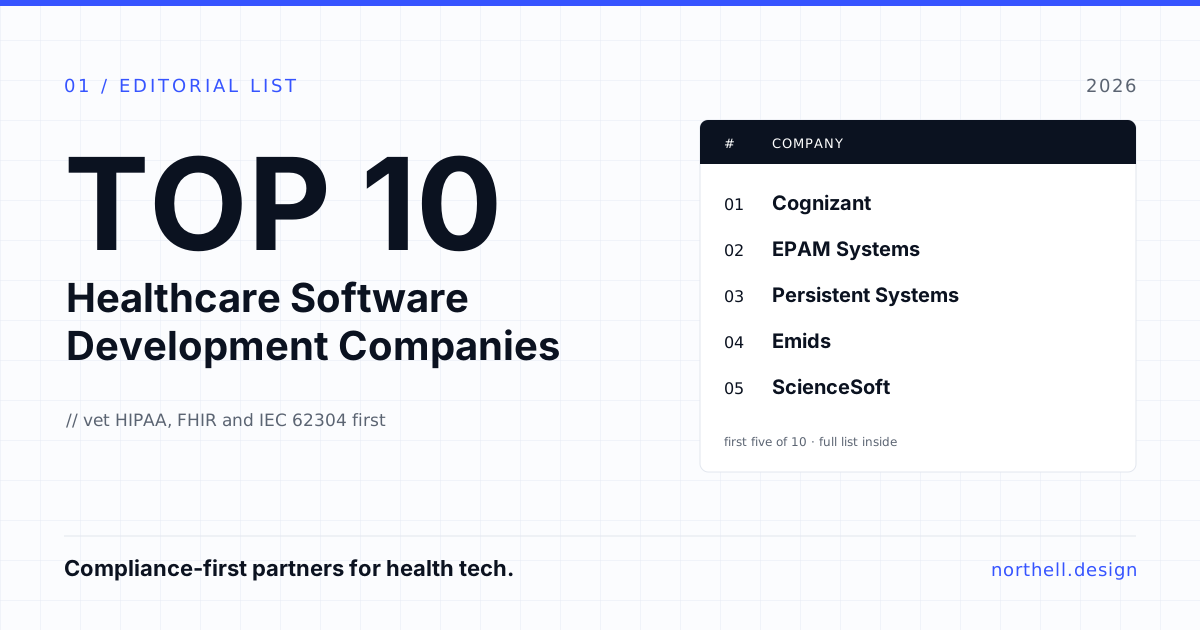
1. Cognizant
Teaneck, New Jersey-based Cognizant has one of the largest healthcare and life sciences businesses of any IT services company, and owns TriZetto, whose software is widely used by US health plans for claims and administration. That combination of platform and services makes it a natural shortlist entry for payers.
Best for: health plans and large providers running enterprise-scale programmes.
2. EPAM Systems
EPAM has a substantial life sciences and healthcare practice, building data platforms, clinical and research software, and digital products for pharmaceutical companies, providers and health tech firms, backed by deep engineering capacity.
Best for: pharma and health tech companies building complex data and product platforms.
3. Persistent Systems
Pune-based Persistent has a large healthcare and life sciences unit serving payers, providers and life sciences companies, with strong product engineering heritage. It is a good fit when a health tech company needs product-grade engineering at scale.
Best for: health tech software companies and payers outsourcing product engineering.
4. Emids
Franklin, Tennessee-based Emids is a healthcare-only technology services firm working with payers, providers, health tech and life sciences companies. A company that does nothing but healthcare brings domain vocabulary and regulatory familiarity that generalists build up project by project.
Best for: organisations that want a partner whose entire business is healthcare.
5. ScienceSoft
McKinney, Texas-based ScienceSoft offers healthcare software development covering patient apps, telehealth, EHR integration, remote monitoring and medical data analytics, and publishes detailed guidance on compliance and costs.
Best for: providers and digital health companies building custom clinical or patient software.
6. Itransition
Denver-based Itransition builds custom healthcare software and integrates platforms such as Salesforce Health Cloud, which helps when part of the answer is a configured platform rather than all custom code.
Best for: projects that combine custom development with healthcare CRM or engagement platforms.
7. Kanda Software
Newton, Massachusetts-based Kanda runs a dedicated healthcare and life sciences practice and acts as a full engineering partner for health tech companies and healthcare solution providers, often taking long-term ownership of product engineering.
Best for: US health tech companies that want a long-term engineering partner.
8. Softeq
Houston-based Softeq combines embedded, firmware, hardware and app development, which is exactly what connected medical and wellness devices need: device firmware, Bluetooth connectivity, companion apps and cloud platforms built by one team.
Best for: connected medical devices and remote monitoring hardware.
9. ELEKS
ELEKS brings data science and research and development strength to healthcare and life sciences work, including analytics, data platforms and custom software where modelling is part of the scope.
Best for: healthcare analytics and data-science-heavy products.
10. Avenga
Avenga has a significant pharma and life sciences practice, including commercial and medical affairs software, data and regulated-environment delivery, alongside general engineering.
Best for: pharmaceutical companies building commercial, medical or data platforms.
At a Glance
| # | Company | HQ | Strongest fit |
|---|---|---|---|
| 1 | Cognizant | Teaneck, NJ, USA | Payers and large providers |
| 2 | EPAM Systems | Newtown, PA, USA | Pharma and health tech platforms |
| 3 | Persistent Systems | Pune, India | Health tech product engineering |
| 4 | Emids | Franklin, TN, USA | Healthcare-only partner |
| 5 | ScienceSoft | McKinney, TX, USA | Custom clinical and patient software |
| 6 | Itransition | Denver, CO, USA | Custom plus healthcare CRM |
| 7 | Kanda Software | Newton, MA, USA | Long-term health tech engineering |
| 8 | Softeq | Houston, TX, USA | Connected medical devices |
| 9 | ELEKS | Ukraine | Healthcare analytics |
| 10 | Avenga | Germany | Pharma and life sciences |
Working on something like this? See our Hire a Dedicated Developer →
The Rules Shaping Healthcare Software in 2026
HIPAA and security. HIPAA's Security Rule still sets the baseline for protected health information in the US, and HHS proposed significant updates in early 2025, including more prescriptive requirements such as encryption and multi-factor authentication. Design as if the stricter version applies.
Interoperability. CMS's Interoperability and Prior Authorization final rule requires most impacted payers to implement FHIR-based APIs for patient access, provider access, payer-to-payer exchange and prior authorization, largely by January 2027. ONC certification rules push providers' systems the same way. FHIR experience is no longer optional.
Medical device software. If your software meets the definition of a medical device, the FDA in the US and the MDR in the EU apply. You will need IEC 62304 software lifecycle processes, ISO 14971 risk management and a quality management system, and a partner that can work inside them.
AI in clinical workflows. AI documentation, triage and decision support are moving fast. Transparency, bias evaluation and human oversight are becoming regulatory expectations, and the FDA continues to publish guidance for AI-enabled device software.
How to Vet a Healthcare Software Partner
- Will you sign a business associate agreement? If the answer is hesitant, stop.
- Show us how PHI is protected in a system you built. Encryption, access control, audit logging and environment separation.
- Which EHRs and FHIR APIs have you integrated with? Name the systems and the scope.
- Have you delivered software under IEC 62304? Essential if your product is, or may become, a medical device.
- How do developers work without real patient data? Look for de-identified or synthetic data practices.
- Can we talk to a healthcare client like us? Payer, provider, digital health and device work differ sharply.
For more on the build itself, see our guides to healthcare software product development, medical device software development and telemedicine software costs, or our healthcare software development service page.
The Bottom Line
For enterprise payer, provider and life sciences programmes, Cognizant, EPAM and Persistent Systems lead this list, with Emids as the healthcare-only alternative. For custom digital health and integration work, ScienceSoft, Itransition and Kanda Software are strong options. For connected devices, Softeq stands out, and for data-heavy or pharma work, ELEKS and Avenga. Whoever you shortlist, vet compliance and security practice first, because in healthcare those are the parts that cannot be fixed later.
If you are scoping a healthcare product and want a second opinion on architecture, compliance or vendor fit, tell us what you are building.
Independent editorial list by the Northell editorial team. No company paid for inclusion, and Northell is not included. Company facts reflect public information available at the time of writing. This article is not legal or regulatory advice; confirm compliance requirements with qualified advisers and current capabilities directly with each vendor.