A mid-market company we talked to last quarter had eleven AI tools running. A Claude subscription for the engineering team. A copilot inside the CRM. Two agent pilots in operations. A meeting summarizer, a support-ticket classifier, a code assistant, a few more. Every one of them worked. Together they compounded nothing. No shared context, no shared permissions, no memory that carried from one to the next. The support classifier could not see what the CRM copilot already knew about a customer, and nobody could give a single agent a permission that spanned both.
The instinct was to blame the models. It was the wrong instinct. MIT's Project NANDA found that roughly 95% of enterprise generative AI pilots produce no measurable impact on profit and loss. Separate research from Anaconda and Forrester puts the number a different way: about 88% of agent pilots never reach production at all. Those failures are not model-quality failures. The models are fine. The tools were bolted onto an application stack that was never designed to be coordinated, and the missing piece is not a smarter model. It is a layer.
That layer is what people mean when they say AI operating system. This article defines the category, gives you a reference architecture you can draw on a whiteboard this afternoon, walks through a staged path to build it, and is honest about where these programs fail and what the intelligence layer cannot replace.
What Is an AI Operating System?
An AI operating system is a coordination layer that manages models, context, permissions, tools, and agents across an organization's existing systems, so that AI can act consistently rather than separately inside each application. It holds the reasoning, the memory, and the access rules that individual apps were never built to share.
The term is used for two different things, and the confusion between them is most of the confusion about the category. One meaning is literal: a computer operating system with a language model in the kernel, deciding how resources are allocated and how the machine responds to natural language. That is real research, and a few systems such as AIOS and Fuchsia-adjacent projects pursue it. It is not what a business means when it asks about an AI operating system.
The second meaning, the one that matters here, is architectural. It is not software you install like Windows or Linux. It is a layer that runs above ordinary infrastructure and coordinates the AI you already have. Saying which of the two you mean is, for most teams, the entire answer to their confusion. The rest of this article is about the second kind.
Is an AI operating system an actual operating system?
Usually not. When a vendor or an analyst says AI OS, they almost always mean the coordination layer, not a kernel. No operating system is being replaced. The metaphor is borrowed because the job is similar, which is worth understanding on its own terms.
The category is not hypothetical. The agent orchestration platform market sits at roughly $3.5 billion in 2026 and is forecast to reach about $14.8 billion by 2031, according to Mordor Intelligence. That growth is not vendors inventing demand. It is enterprises discovering that a pile of agents without a coordination layer stays a pile.
Why "Operating System" Is the Right Metaphor, and Where It Breaks
The metaphor earns its keep on four counts, and each one maps cleanly onto the AI case. A traditional operating system allocates a scarce resource: CPU time and memory. In the AI layer, the scarce resource is compute and context-window space, and something has to decide which task gets it. A traditional OS mediates access to hardware. Here, the hardware is your tools and data sources, and the layer mediates which agent reaches which system. A traditional OS provides a common interface so applications do not each reinvent file access. Model Context Protocol and typed APIs now play that role for agents. And a traditional OS enforces isolation between processes, so one crash does not take down the machine. Permission scoping does the same for agents, keeping one from acting outside its lane.
That common-interface leg used to be aspirational. It is not anymore. Model Context Protocol, released by Anthropic in late 2024, reached roughly 97 million monthly SDK downloads by March 2026, up from about 100,000 at launch. Around 28% of Fortune 500 companies have deployed MCP servers. The standard interface the metaphor depends on is now something you can actually build on.
The metaphor also breaks, and anyone who takes it literally will design the wrong thing. A real operating system is deterministic: the same call returns the same result. The intelligence layer is probabilistic, and it can be confidently wrong. A real operating system owns the machine and has privileged control over everything on it. The intelligence layer owns nothing. It has to negotiate with systems of record, compliance surfaces, and vendor apps that will not hand over control. It is less a kernel than a diplomat with a scheduler.
The App Stack Problem: Why SaaS Architecture Caps AI Value
To see why a coordination layer is necessary rather than nice, look at the shape of the applications it coordinates. A SaaS application is three things stacked together: a database, business logic, and a user interface. For twenty years those three were bundled because a human needed the interface to reach the logic, and the logic needed to live somewhere close to the data. That bundle was the product.
An agent does not need the interface. Satya Nadella has argued the point bluntly: business applications are essentially CRUD databases with business logic layered on top, and agents become "multi-repo CRUD," operating across many systems rather than inside one. Jefferies analysts coined a term for the market anxiety this created in early 2026: "SaaSpocalypse." Sentiment, though, is not architecture, and the interesting part is not the slogan. It is the concrete consequence.
When the business logic moves up into a shared layer, the AI feature bolted onto each individual application becomes redundant. This is why per-app copilots plateau. Each vendor's copilot sees only its own data. It holds no memory of what happened in the neighboring system. It cannot be granted a permission that spans two applications, because no application owns both. Three copilots is not one assistant with three skills. It is three strangers who happen to work in the same building. The value of an application starts to shift almost entirely toward the correctness and governance of its data, because the reasoning that used to justify the interface is moving somewhere the interface cannot follow. That "somewhere" is the intelligence layer.
What does the intelligence layer sit on top of?
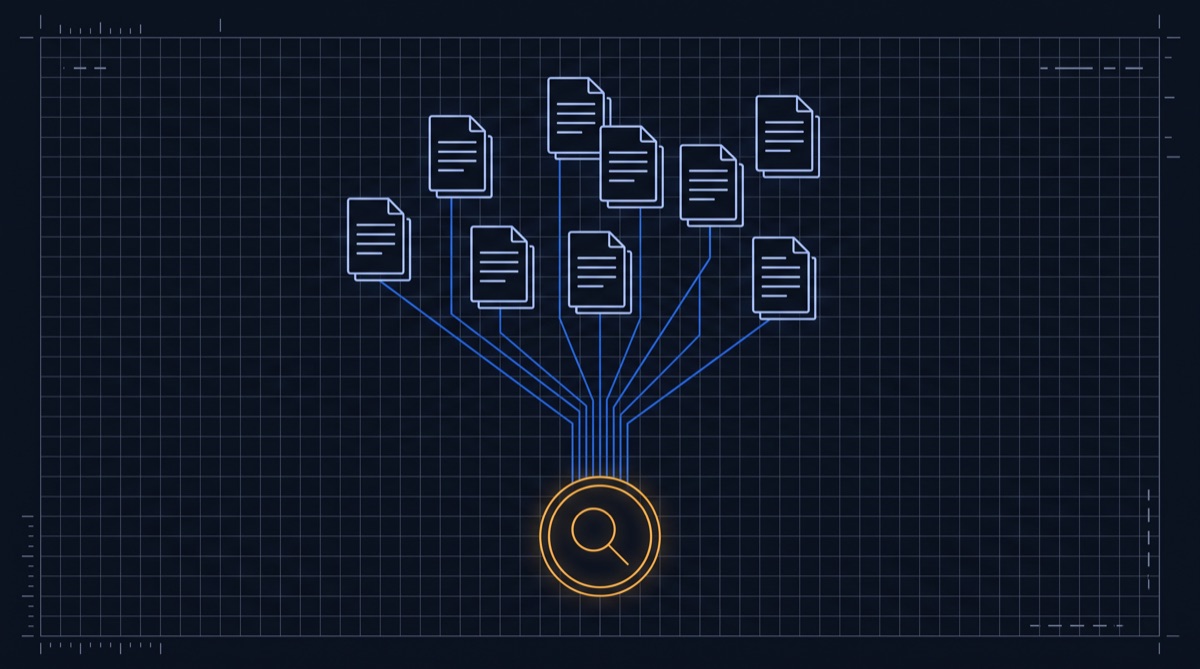
It sits on top of your existing systems of record: the CRM, the ERP, the ledger, the data warehouse, the internal tools. It does not replace them. It reaches into them through a standardized interface, reads and writes across several at once, and holds the context and permissions that no single one of them can. For a picture of what those underlying systems look like when they are built to be coordinated rather than siloed, our work on enterprise software development starts from that assumption.
Working on something like this? See our Claude Agent Development →
Anatomy of the Intelligence Layer: A Reference Architecture
Strip away the vendor language and a working AI operating system has seven components. Each one does a specific job, each one breaks the system in a specific way when it is missing, and most teams get one or two of them wrong the first time. None of these is a product name. They are functions, and you can assemble them from open protocols, buy them, or build them.
01 / Context and memory layer. Retrieval, working memory, and the record of what the system already did. Without it, agents repeat work and contradict each other, because each request starts from zero. Teams usually treat this as "just add RAG" and discover that retrieval without memory produces an agent that is well-read and amnesiac. The depth here is its own subject; we covered part of it in building an AI knowledge base for your team.
02 / Tool and data interface layer. The standardized way agents reach systems, which in practice means MCP servers and typed APIs. Without it, every integration is bespoke and every model swap becomes a rewrite. This is where the "common interface" from the operating-system metaphor actually lives, and where Claude API enterprise integration tends to start.
03 / Identity and permission model. Which agent may act as whom, on what, and up to what threshold. This is the single most-skipped component and the most common reason a promising pilot stalls for a quarter. A human user has a role and a set of scopes. A non-human actor needs the same, and almost nobody designs it before they need it.
04 / Orchestration and routing. Deciding which model or agent handles a task, in what order, with what escalation when confidence is low. Model choice belongs here, and choosing between models is a large enough topic that we keep it out of scope for this article and handle it separately in our comparison of which model should power each task. If you need routing built as a durable capability rather than a script, that is the province of enterprise AI reasoning engines.
05 / Evaluation and observability. Traces, evaluations, drift detection, and cost per task. Without it, there is no way to distinguish a degraded system from a bad afternoon, and no basis for expanding an agent's scope. Cost sits here too, and what agent workloads actually cost to run is a number most teams cannot produce until this layer exists.
06 / Human interface layer. Where people approve, correct, and take over. This is the layer that decides adoption, and it is the one nearly every competing description of an AI operating system omits entirely. An agent that is technically capable but expensive to supervise gets abandoned, quietly, within a month.
07 / Governance and audit. The immutable record of what was decided and on whose authority. In regulated sectors this is the gate, not a finishing touch. If you cannot reconstruct why an agent did something, you cannot run it anywhere near a ledger or a patient record.
The failure data maps almost one-to-one onto these components. Forrester's root-cause analysis of agent failures attributes 41% to unclear success criteria, 33% to insufficient tool or data access, and 26% to drift in evaluation coverage. Read those against the list: unclear success criteria is a missing evaluation layer, insufficient tool or data access is a missing interface and permission model, and evaluation drift is observability that was never built. The failures are not exotic. They are named components that were skipped.
AI Operating System vs. AI Platform vs. Agent Framework vs. RPA
The category is crowded with terms that sound interchangeable and are not. The distinction is worth holding before any procurement conversation, because most vendors calling their product an AI operating system are selling one of its seven components, usually orchestration, and describing it as the whole.
| Dimension | AI Operating System | AI Platform | Agent Framework | RPA |
|---|---|---|---|---|
| What it is | Coordination layer across systems | Hosted place to build and run AI | Library for building one agent | Scripted task automation |
| Scope of control | Many agents, many systems | Whatever you build on it | A single agent's logic | One fixed process |
| Who owns the logic | Shared layer | You, inside the platform | You, in code | The script |
| When a process changes | Reconfigure the layer | Rebuild on the platform | Rewrite the agent | Rebuild the script |
| Typical buyer | CTO, Head of Platform | Engineering team | Individual developer | Ops team |
A framework is a library you build a single agent with. A platform is a hosted place you build and run inside. RPA scripts a fixed path and breaks when the path changes. An AI operating system is the coordination layer that may sit above all three. You can build the layer using a framework, host parts of it on a platform, and even wrap a legacy RPA job as one tool the layer can call. They are not competitors on a shelf. They are different altitudes.
What the Intelligence Layer Actually Replaces, and What It Doesn't
Two honest columns. The intelligence layer absorbs a real, growing set of work, and it provably does not touch another set. Confusing the two is how programs overreach and then collapse.
What it absorbs: routine cross-system workflows, the kind that involve pulling from one system, deciding, and writing to another. Most internal reporting and status-chasing. The dashboard as an interface, since asking a question in plain language beats hunting through a dashboard for most people. Tier-one triage and classification. And a large share of the per-app copilots bolted on since 2024, which were always a stopgap for the absence of a coordination layer. That last category is broad; a good deal of it is what we build under Claude business automation.
What it does not absorb, and here it is worth being firm: systems of record. Transactional integrity. Regulatory and audit surfaces. Deeply specialized domain software that encodes decades of edge cases. And anything where a deterministic guarantee is the product itself. A ledger that is right 99.4% of the time is not a ledger. This is exactly why fintech software development keeps the ledger deterministic and lets the intelligence layer sit beside it, never inside it.
The useful conclusion is not that SaaS dies. It is that SaaS gets demoted from interface to data source. That is a larger commercial change than a technical one, and it happens gradually. The proof that it is already underway sits in a gap between two numbers: more than 80% of Fortune 500 companies now run AI agents in production, yet only about 14% of enterprises have scaled a single agent to organization-wide use, according to a March 2026 survey of 650 technology leaders. Almost everyone has agents. Almost no one has coordination. The distance between those two figures is precisely the layer this article is about.
The Four-Stage Path to an AI Operating System
You do not buy an AI operating system for your business and switch it on. You grow one, in four stages, and skipping a stage is how the 88% end up in the pile that never reaches production.
Stage 1 — Inventory and contain. Map every AI tool in use, what data each one touches, and under whose credentials it runs. Most teams discover more than they expected, including a few tools nobody sanctioned. For a mid-market company this is weeks, not quarters, and it is the cheapest insurance you will ever buy.
Stage 2 — Standardize access. Build one interface layer to your systems and one permission model, before you add a single new agent. This is the point where MCP and a real identity model for non-human actors go in. Also weeks. Doing it now costs a fraction of retrofitting it later.
Stage 3 — Instrument before you scale. Put evaluations, traces, and cost-per-task on the two or three agents you already have. This is the stage nearly everyone skips, and it is the reason pilots stall at 10% of their intended volume. If you cannot measure whether an agent got worse, you will never be allowed to give it more to do.
Stage 4 — Coordinate. Now, and only now, add shared memory, routing between agents, and clean human handoff. This is the stage where the term "operating system" becomes accurate rather than aspirational. It is a quarter or more of work, and it depends far less on model tuning than on identity, data access, and approval design.
This staging is not theoretical for us. We run our own production agents and publish their status on our homepage: 99.982% uptime over 90 days across six client platforms, p95 latency at 142 milliseconds, and named agents such as RECON-AGENT, LEDGER-SYNC, and AUDIT-WATCH with their live queue depth visible. We put instrumentation in before scale because instrumenting agents before scaling them is the practice we hold ourselves to first. That discipline is the core of our AI development services. When Stage 4 arrives and you need the coordination logic built as a durable capability, the tactical mechanics of building a multi-agent AI workflow are a separate walkthrough.
Where AI Operating System Programs Fail
Three failure modes account for most stalled programs. Each has a symptom you can spot early, a root cause, and a fix. Naming them is the point, because a failure you can name is a failure you can design against.
The permission cliff. The agent works flawlessly in the demo and then cannot be granted production access, because nobody built an identity model for non-human actors. The symptom is a pilot that is "blocked on security" for a quarter while everyone waits for a decision that was never anyone's job to make. The fix is Stage 2: scope agent permissions the way you scope a human role, before the demo, not after.
The evaluation vacuum. Nobody can tell whether the system got better or worse, so nobody will approve expanding its scope. The symptom is an agent frozen at a fraction of its intended volume, indefinitely, because expansion feels like gambling. The fix is Stage 3: instrument first, so that scope decisions rest on traces and cost curves rather than on nerve.
The interface tax. The layer works, and people route around it anyway, because approving an agent's action costs more attention than just doing the task by hand. The symptom is high build cost and near-zero usage. This is the one to take seriously, because it is where most AI operating system programs fail: at the interface layer, not the model layer. The model was never the bottleneck. The bottleneck was that supervising the agent was more expensive than the work it did. The fix lives in component 06, and it is a design problem, not a modeling one.
Build, Buy, or Assemble
Three paths, and the honest read on each matters more than the pitch. Buying a platform is fastest to a working demo and weakest on your specific permission and data model, and the lock-in at the orchestration layer is real, so read the exit terms. Building entirely in-house is the right call when the coordination logic is a genuine competitive asset, and an expensive mistake when it is not. Assembling on open protocols, MCP and typed interfaces with components you own, is the pragmatic middle for most mid-market teams, and the adoption curve behind those protocols now supports it in a way it did not a year ago.
The decision comes down to four questions. How much regulatory exposure do you carry, since that raises the bar on the governance and audit component. How unusual are your workflows, because the more standard they are, the more a bought platform fits. Whether you have platform engineers to spare. And how fast your processes change, because a fast-changing process punishes anything scripted or vendor-locked. For a lighter build where an app builder might suffice, we drew the line in when an AI app builder is enough.
Northell builds this layer for fintech, healthtech, and SaaS teams: agents with sandboxed reasoning and auditable decision paths, and the monitoring to prove they hold up after launch. If you want a concrete architecture rather than another framework comparison, that is what an LLM reasoning layer for enterprise software is for. Book an architecture review and we will map your stack, name the components you are missing, and tell you which stage you are actually at.
Conclusion
Come back to the eleven tools and the nothing they compounded. The problem was never the models, and it was never a missing feature. It was that no layer held the context, the permissions, and the memory that would let those tools act as one system instead of eleven strangers. An AI operating system does not so much replace the app stack as demote it: the applications keep the data, and the reasoning moves up into a coordination layer above them. The work is coordination, not capability.
The first move is the cheapest one. Before you evaluate a single platform, map what your agents already touch, and under whose credentials they touch it. That inventory tells you which of the seven components you have, which you are missing, and which stage you are actually standing on. Everything after that is easier once you can see the layer you have been building by accident.
Written by the Northell Team — the engineers who build and monitor production AI systems, fintech infrastructure, and custom platforms; the status feed referenced above is our own. Book an architecture review.
Sources: MIT Project NANDA; Anaconda / Forrester agent-pilot research; Forrester root-cause analysis; March 2026 survey of 650 enterprise technology leaders; Model Context Protocol adoption data and official roadmap; Mordor Intelligence agent orchestration market report; public remarks by Satya Nadella.