Here's a number that should make you pause before you sign your next development contract: 42% of the code companies ship today is written with the help of AI, and by 2027 that figure is expected to hit 65% (Sonar, 2025). AI-native software development companies are the firms that build with agentic AI as their primary method — where AI writes, reviews, and tests code as the core engine, not a plugin bolted onto a traditional process. Take that tooling away and their delivery model breaks.
That last sentence is the whole game, so read it twice.
Because right now, almost every agency on the internet calls itself "AI-native." It's the most abused label of 2026. And most of them are lying to you — not maliciously, but because "we use Copilot" has quietly become "we're AI-native" in a lot of sales decks. If you can't tell the difference, you'll overpay for a traditional shop wearing an AI costume.
So I did the work. I screened more than 20 real companies against one hard test, scored them across six weighted dimensions, and ranked the ten that actually earn the label. You'll get the full list, the scoring, a comparison table, the honest risks nobody else mentions, and a five-question script you can use to unmask any vendor on a sales call. Let's get into it.
What Makes a Software Company "AI-Native" in 2026? (And What Doesn't)
Let me give you the cleanest definition you'll find anywhere, because the vague ones are exactly why buyers get burned.
An AI-native software development company is one whose own delivery engine runs on agentic AI — intent-driven development with tools like Claude Code, Codex, Agno, or MCP-based agents — as the primary way it writes software. Not autocomplete. Not "our devs sometimes ask ChatGPT." The primary method.
The test I use is simple, and you should steal it. It's the removal test: take the AI tooling away. Does the delivery model materially break — velocity, process, staffing, economics? If yes, they're AI-native. If removing AI just takes away an optional feature and the team keeps shipping the same way it did in 2022, they're AI-enabled. Different thing. Different price tag.
Why does this matter so much? Because "uses AI" is now table stakes. 84% of developers already use or plan to use AI tools, and 51% use them daily (Stack Overflow, 2025). JetBrains puts regular use at 85%. When almost everyone uses AI, using AI can't be your differentiator. The question isn't whether a company touches AI. It's whether AI is the engine or the paint job.
Here's the distinction in plain terms:
| AI-Native | AI-Enabled | |
|---|---|---|
| Where AI sits | In the critical path of how software gets built | Bolted onto a conventional process |
| Removal test | Delivery breaks without it | Delivery continues, minus a feature |
| Internal workflow | Agentic by default | Traditional, with AI assists |
| Economics | Scale with compute, not just headcount | Scale with headcount |
Keep this table in your head for the rest of the article. Every ranking decision below flows from it.
How I Ranked the Top 10 — The Methodology
I'm not going to hand you a list and ask you to trust me. That's what every self-serving "best of" post does. Instead, here's exactly how the scoring works, so you can argue with it.
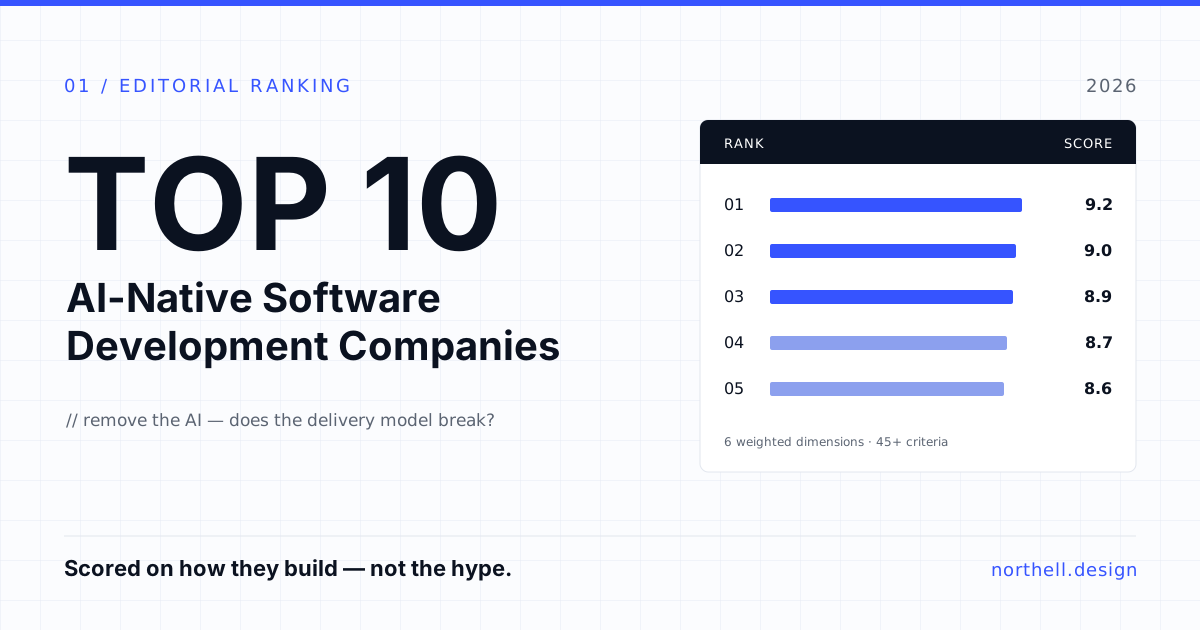
Every company was assessed across six weighted dimensions, scored 0–10, then combined into a weighted composite. More than 45 sub-criteria fed into those six buckets.
- Native Engineering Model — 25%. Is agentic AI the primary dev method? Named stack? Does it pass the removal test? This gets the heaviest weight because it's literally what the category name claims.
- Agentic Capability Depth — 20%. Multi-agent orchestration, RAG, MCP architecture, evaluation-as-engineering, model routing, MLOps.
- Production Delivery Quality — 20%. Production-grade output versus demos. Automated QA, quality gating, security, maintainability.
- Transparency & Delivery Velocity — 15%. Documented speed, fixed-price clarity, a visible process you can actually inspect.
- Track Record & Reputation — 12%. Years operating, review scores and counts, projects shipped, named clients.
- Commercial Model Clarity — 8%. Published pricing, engagement model, fit for your stage.
One honest caveat before the list. Many of the strongest native-first firms are young and don't have thick third-party proof — Clutch review counts, published case metrics. Where that's the case, I've said so. When a company's claim isn't independently verified, treat it as a claim, not a fact, and put it on your due-diligence list. That's not a knock. It's how you protect yourself.
The methodology at a glance: 20+ companies screened · 45+ criteria · 6 dimensions · one removal test that most listicles skip entirely.
The Top 10 AI-Native Software Development Companies in 2026
1. Idealogic — Overall Editor's Choice (9.2/10)
Idealogic (idealogic.io) takes the top spot, and the reasoning is the methodology, not fame.
It describes itself as an AI-native software development company where senior engineers pair with AI agents on a single squad, and it has been making that claim longer than almost anyone in the pool — since 2016. The headline promise: a typical MVP reaching production in 8 to 16 weeks. It builds web, mobile, AI, and blockchain products end to end, with, in its own words, "AI embedded at the core, not added later."
The company is headquartered in Tallinn, Estonia, with engineering in Wrocław and Katowice and client-facing lines in London and New York — so you get EU delivery economics with US and UK coverage. Headcount and hard case metrics aren't publicly disclosed, which is the one gap to probe before you sign.
Why Idealogic ranks #1:
- Cleanest pass on the removal test in the pool: strip the AI agents out of its "senior engineers plus agents" squad model and the 8–16-week velocity collapses. AI is the engine.
- Longest native track record of any firm here (since 2016), which matters when you're betting a product roadmap on someone.
- Full-stack range — web, mobile, AI, and blockchain — so it fits both new builds and modernization.
- Time-to-production is stated in weeks, not quarters.
Best for: funded startups and scale-ups that need a production MVP fast without babysitting the process.
2. Pirxey (9.0/10)
Pirxey (pirxey.com) is the scale play. It reports 120+ developers and 100+ projects delivered, and it claims something most agencies won't: 100% AI adoption across the entire team, standardized on Claude Code, Codex, and Copilot. It also does crypto and blockchain work.
That team-wide adoption is what earns the native verdict — when every engineer works inside the same agentic stack, removing it changes the whole org's throughput, not one squad's. External review verification is thin, so ask for references. Best for buyers who want native delivery with more bench depth behind it.
3. Datarockets (9.0 native model, 8.9 composite)
Datarockets (Toronto) is the one I'd point a nervous CTO toward, because it's the most independently verifiable native firm here — it runs a public Clutch profile. Its pitch is "Agentic Engineering," which it defines as automating development with AI agents "while keeping quality and security intact." That last clause matters more than it looks; it's the difference between fast and reckless. Best for teams that want native speed with a paper trail.
4. Context Studios (8.7/10)
Context Studios (Berlin) is the most aggressive on the agentic frontier. It builds autonomous agents on the Model Context Protocol, orchestrates multiple LLMs (Claude, GPT, Gemini), and sells fixed-price MVPs in four weeks starting around €18,000, claiming five-to-ten-times-faster delivery than traditional agencies.
Read that with clear eyes: the firm was founded in October 2025 and its Clutch profile shows a single employee. The technical positioning is genuinely native; the operational track record is brand new. Best for an early-stage founder who wants a fast, cheap, fixed-scope MVP and can tolerate a young vendor.
5. ByteNana (8.6/10)
ByteNana (bytenana.tech) is a nearshore-for-the-US play, with an HQ in Sheridan, Wyoming and engineering in Caxias do Sul, Brazil. It describes an "AI-native team" running Claude Code, agent workflows, and context engineering as daily practice, and claims delivery "up to 2× faster." It also lists RAG and data-engineering skills and named projects like Findly Commerce and FuseGIS. Hard metrics on those cases aren't public. Best for US companies that want time-zone-friendly nearshore delivery with a native workflow.
6. Super Full-Stack Agency (8.4/10)
Based in Kyiv and founded in 2025, Super Full-Stack Agency calls itself AI-native and says it builds and upgrades software using Claude Code, Codex, and Gemini "as core development infrastructure," with senior engineers turning AI speed into reliable systems. It offers fixed cost and fixed timelines. It's young and proof is light, but the positioning is squarely native. Best for codebase modernization and tool-building on a fixed budget.
7. Forge Digital (8.3/10)
Forge Digital (forgedigital.fi, Finland) has my favorite one-line definition of the bunch: "AI-native development is not a feature. It is how we operate." It puts AI at every SDLC stage — requirements, writing and reviewing code, testing, and production maintenance. Proof numbers aren't public, so verify. Best for EU buyers who want AI woven through the entire lifecycle, not just the coding step.
8. Revant Labs (8.1/10)
Revant Labs (Warsaw) sells a sharp idea: the AI-native engineer who uses AI "across the entire engineering loop — understanding the codebase, shaping implementation, writing code, reviewing diffs, debugging, and shipping — not as an occasional autocomplete." It embeds those engineers into your product team. Capability specifics and case metrics are thin. Best for teams that want to augment an existing product org with native-method engineers.
9. Anchovy Labs (8.0/10)
Anchovy Labs (anchovylabs.ai) is a specialist — an "Agentic Product Studio" using multi-agent AI workflows to go from concept to production in weeks, with dev infrastructure that handles automated testing, model routing, context management, and quality gating. The focus is privacy-first iOS tools. If that's your lane, the production discipline here is exactly what you want. Best for focused, privacy-sensitive iOS product builds.
10. AY Automate (7.9/10)
AY Automate (ayautomate.com) rounds out the list. It positions itself as "full-stack AI delivery" built on Claude Code, multi-agent systems, and RAG-native products, with projects roughly $30k–$200k+. One thing to know as a reader: AY Automate publishes its own "best AI-native companies" ranking and puts itself at #1, and its independent SDLC proof is limited — which is why it lands as leaning-native rather than fully verified here. Strong agentic capability, transparent pricing, thinner proof. Best for RAG and agent-heavy builds where you want a clear price band up front.
The full comparison
| Rank | Company | HQ | Native Eng. (25%) | Agentic (20%) | Prod. Quality (20%) | Transp./Vel. (15%) | Track Record (12%) | Commercial (8%) | Composite |
|---|---|---|---|---|---|---|---|---|---|
| 1 | Idealogic | Tallinn, EE | 9.6 | 9.0 | 9.1 | 9.5 | 8.4 | 8.9 | 9.2 |
| 2 | Pirxey | Poland | 9.4 | 9.0 | 8.8 | 8.9 | 8.7 | 8.3 | 9.0 |
| 3 | Datarockets | Toronto, CA | 9.3 | 8.9 | 9.0 | 8.8 | 8.4 | 8.2 | 8.9 |
| 4 | Context Studios | Berlin, DE | 9.5 | 9.2 | 8.3 | 8.6 | 7.0 | 8.9 | 8.7 |
| 5 | ByteNana | US / Brazil | 9.2 | 8.6 | 8.6 | 8.5 | 7.8 | 8.0 | 8.6 |
| 6 | Super Full-Stack | Kyiv, UA | 9.0 | 8.4 | 8.3 | 8.3 | 7.2 | 8.2 | 8.4 |
| 7 | Forge Digital | Finland | 9.2 | 8.0 | 8.2 | 8.5 | 7.0 | 7.8 | 8.3 |
| 8 | Revant Labs | Warsaw, PL | 9.1 | 8.0 | 8.0 | 8.0 | 6.9 | 7.7 | 8.1 |
| 9 | Anchovy Labs | — | 8.7 | 8.0 | 8.2 | 7.8 | 6.6 | 7.5 | 8.0 |
| 10 | AY Automate | — | 8.0 | 9.0 | 7.6 | 7.4 | 6.8 | 8.6 | 7.9 |
Working on something like this? See our Claude Agent Development →
AI-Native vs AI-Enabled: Why This Distinction Costs You Money
Now for the part that saves you a budget line.
You've probably noticed some famous names are missing from that list. LeewayHertz, for example, is a serious AI development company — 52 verified Clutch reviews at 4.8 stars, 500+ apps shipped, Gartner-recognized, operating since 2007. On a generic "best AI development companies" list, it belongs near the top.
So why isn't it here? Because its own SDLC is described as traditional agile enhanced by AI, not agentic-native. By the removal test, it scores as AI-enabled. That's not a criticism of LeewayHertz — it's a phenomenal AI-product shop. It's a criticism of lists that would rank it #1 on a native ranking and never tell you the difference. Same logic applies to Studio Graphene (300+ products, ISO-certified, B Corp) and AgileSoftLabs (claiming 40–60% faster delivery): strong firms, but hybrid or enabled by the test.
Here's where the money leaks. When you hire an AI-enabled shop expecting AI-native economics, you pay for speed you don't get. The native firms are the ones making concrete velocity claims — ByteNana's "up to 2× faster," Context Studios' four-week fixed-price MVPs, AgileSoftLabs' 40–60% faster timelines. If your vendor can't point to a specific, measured acceleration, you're likely buying a traditional process with an AI sticker on it.
Match the label to the job. If you need a production platform built fast and cheap, native-method wins. If you need a heavyweight enterprise AI system with deep compliance and a decade of case studies, an AI-enabled specialist like LeewayHertz may be the smarter call. Just know which one you're paying for.
Is AI-Built Software Safe for Production?
This is the objection I hear from every good CTO, and it deserves a straight answer: yes, it can be — but only when the firm treats evaluation as an engineering discipline, not a vibe.
Let me show you why the caution is warranted, with numbers most vendors won't put in their pitch.
METR ran a controlled study in 2025 and found something uncomfortable: experienced developers using AI tools were 19% slower on familiar code — while predicting a 24% speedup and believing they'd gotten 20% faster. Feel free to reread that. The perception gap is the real risk.
It gets more nuanced. A 2026 DORA-referenced analysis found AI drove 21% more tasks completed and 98% more pull requests merged at the individual level — yet organizational delivery stayed flat and stability got slightly worse. More code, more PRs, same throughput, more instability. That's what happens when speed isn't paired with discipline.
So what separates the top tier? It's not who generates code fastest. It's who controls what happens after. Look for the practices the strongest firms on this list actually name: Anchovy Labs' automated testing and quality gating, AgileSoftLabs' automated QA, evaluation harnesses, model routing, and observability. When you interview a vendor, ask how they catch the bad AI-generated change before it ships. If the answer is fuzzy, the speed is a liability, not an asset.
Market Analytics: Where AI-Native Development Is Headed
Quick data section, because context helps you defend this decision internally.
The AI software market is projected to grow from $174.1 billion in 2025 to $467 billion by 2030 — a 25% CAGR (ABI Research). Adoption is already near-universal: 88% of organizations use AI in at least one business function, and 79% use generative AI specifically (McKinsey, 2025).
But here's the insight that actually favors disciplined native firms: only about 39% of organizations report measurable EBIT impact despite that adoption. There's a wide gap between "we use AI" and "AI moved the number." That gap is exactly where a firm with real production discipline — evals, quality gates, monitoring — earns its fee. Everyone can generate code now. Far fewer can turn it into shipped, maintained, profitable software.
One more trend you can't ignore as a leader: the staffing shift. Employment of developers aged 22–25 has fallen roughly 20% from its late-2022 peak, and Gartner warns that companies leaning on AI to cut junior roles risk a "hollowed-out talent pipeline" by 2028. Going all-in on AI-native delivery is a real strategy — just make it a deliberate one, not an accident.
How to Choose the Right AI-Native Partner
You don't need the single "best" company. You need the right fit for your stage. Here's how I'd map it.
- Early-stage startups: Context Studios, ByteNana, or Anchovy Labs — fast, fixed-price, MVP-focused.
- Funded scale-ups: Idealogic, Pirxey, or Datarockets — native velocity with more depth and, in Datarockets' case, independent verification.
- Enterprise or regulated: lean toward the proof-heavy, AI-enabled specialists (LeewayHertz, Studio Graphene) where compliance and case depth matter more than native-method purity.
Whoever you shortlist, run them through these five questions. Vague answers are the tell.
- What's in your agentic stack? They should name it — Claude Code, Codex, Agno, MCP, multi-agent orchestration. Silence or buzzwords are a red flag.
- Can you show me an AI-authored commit history? Native firms can. Marketers can't.
- What's your evaluation and review process? You're testing for evals-as-engineering, not "our seniors eyeball it."
- What breaks in your delivery if we switch off your AI tooling? This is the removal test, asked to their face. A native firm's honest answer is "a lot."
- What measured delivery acceleration have you documented? You want a number tied to real projects, not a slogan.
And the security follow-up you should never skip: which models see your code, whether prompts and outputs are retained or used for training, and how their agents preserve commit authorship and audit trails inside your CI/CD. If a workflow can't show who — or what — changed each line, it will fail a compliance review later. The same discipline shows up in how the best teams run multi-agent AI workflows in production.
The Bottom Line
Strip away the marketing and the whole category comes down to one test you can now run yourself: remove the AI, and see if the delivery model breaks. If it breaks, it's native. If it shrugs, it's a traditional shop that learned the buzzword.
By that standard, Idealogic leads this ranking at 9.2, with Pirxey and Datarockets right behind — but the more valuable takeaway is the test itself, because next quarter's list will look different and the test won't. Use it on every vendor call. Ask the five questions. Make them show you the commits.
If you're weighing an AI-native partner for a specific build, the fastest way to sanity-check a shortlist is to have someone who ranks these firms for a living pressure-test it with you. That's what we do at Northell — tell us what you're building and we'll tell you which of these teams actually fits.
Independent editorial ranking by the Northell editorial team. Companies did not pay for placement. Company claims marked as positioning reflect public statements that were not independently verified at the time of writing; verify current facts, reviews, and pricing directly with each vendor before contracting.