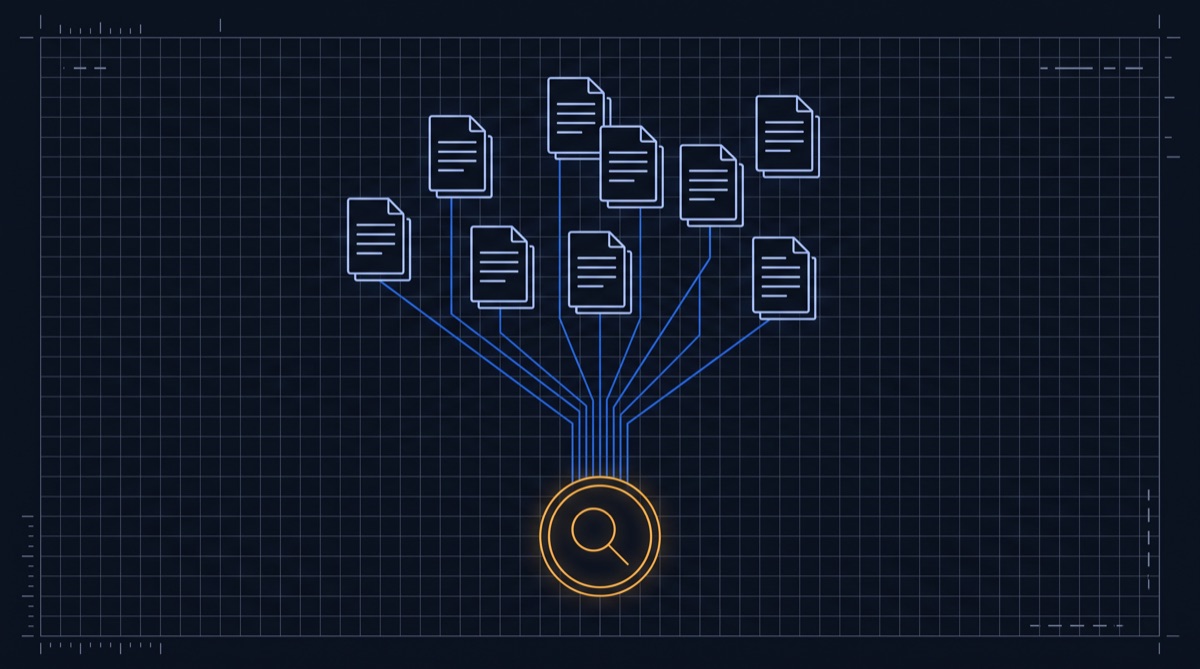
Why Generic "Second Brain" Advice Doesn't Transfer to an Engineering Team
Personal knowledge-management methods are built around one person's notes, revisited by that same person, with an implicit understanding of context that never needs to be written down. An engineering team's knowledge base has to work for people who weren't there when a decision was made, which means it needs actual structure: clear ownership, a source of truth per topic, and a way to tell an outdated answer from a current one.
The teams that get real value out of this treat it less like a personal wiki and more like a lightweight internal product — something with an owner, a maintenance process, and a defined scope, not a folder of everything anyone ever wrote down.
What to Feed It: Sourcing Docs, Runbooks, and Decisions Without the Noise
Start narrow: architecture decisions, on-call runbooks, onboarding docs, and answers to the questions that get asked repeatedly in Slack. Resist the urge to import every historical Slack thread and old meeting note on day one — noisy, contradictory, or outdated source material produces noisy, contradictory, or outdated answers, no matter how good the model synthesizing them is.
Key takeaway: a knowledge base built from 20 well-maintained documents beats one built from 2,000 unmaintained ones — source quality determines answer quality more than volume does.
Retrieval Is the Hard Part, Not the Model
Most disappointing results trace back to retrieval, not the model. A system that chunks documents poorly, or ranks by loose semantic similarity instead of actual relevance, will hand the model a plausible-looking but wrong chunk of context — and Claude will answer fluently based on it, which is worse than an obvious failure because it reads as confident and correct.
Getting this right usually means structuring source documents with clear headings the chunker can respect, testing retrieval against real questions engineers actually ask, and reviewing a sample of retrieved-context-plus-answer pairs by hand before trusting the system broadly. This is the core of what custom Anthropic LLM development work actually involves for internal tools like this — the model integration is the easy part.
Working on something like this? See our Claude Agent Development →
Retrieval Approaches Compared
| Approach | Best For | Tradeoff |
|---|---|---|
| Structured keyword / hybrid search | Well-organized docs, clear headings, moderate volume | Misses loosely-worded or conceptual queries |
| Vector / semantic search | Large, varied content, conceptual questions | Needs tuning to avoid confidently-wrong near-matches |
| Full context reinjection (no retrieval) | Very small, stable document sets only | Expensive and slow past a small scale |
Keeping It From Going Stale: An Ownership Model, Not a One-Time Import
The single biggest predictor of long-term success is whether someone owns keeping each source document accurate. Whoever owns the underlying system or process should own its knowledge-base entry, the same way they'd own its runbook — a shared, ownerless doc is the fastest path to confidently wrong answers six months from now.
A lightweight review cadence (a quarterly pass on high-traffic documents, a required update whenever the underlying system changes) costs far less than the trust lost when someone follows a stale answer into a production incident.
A Simple Architecture You Can Actually Ship
1. Source docs (structured, owned, versioned)
2. Chunking + indexing (respects headings, not arbitrary splits)
3. Retrieval layer (hybrid or vector, tested against real queries)
4. Claude (synthesizes an answer from retrieved context only)
5. Feedback loop (flag wrong answers -> fix the source doc)
Notice the model sits fourth in that list, not first — most of the engineering effort belongs in steps 1 through 3. If you're already running agent workflows elsewhere in the business, this same retrieval layer is what keeps them grounded in current information instead of stale training data, and the same token-cost discipline from reducing Claude API costs applies directly here, since retrieval calls add up fast at scale. For teams ready to build this properly rather than bolt it onto an existing chat tool, our Claude enterprise implementation work is built around exactly this kind of internal system.