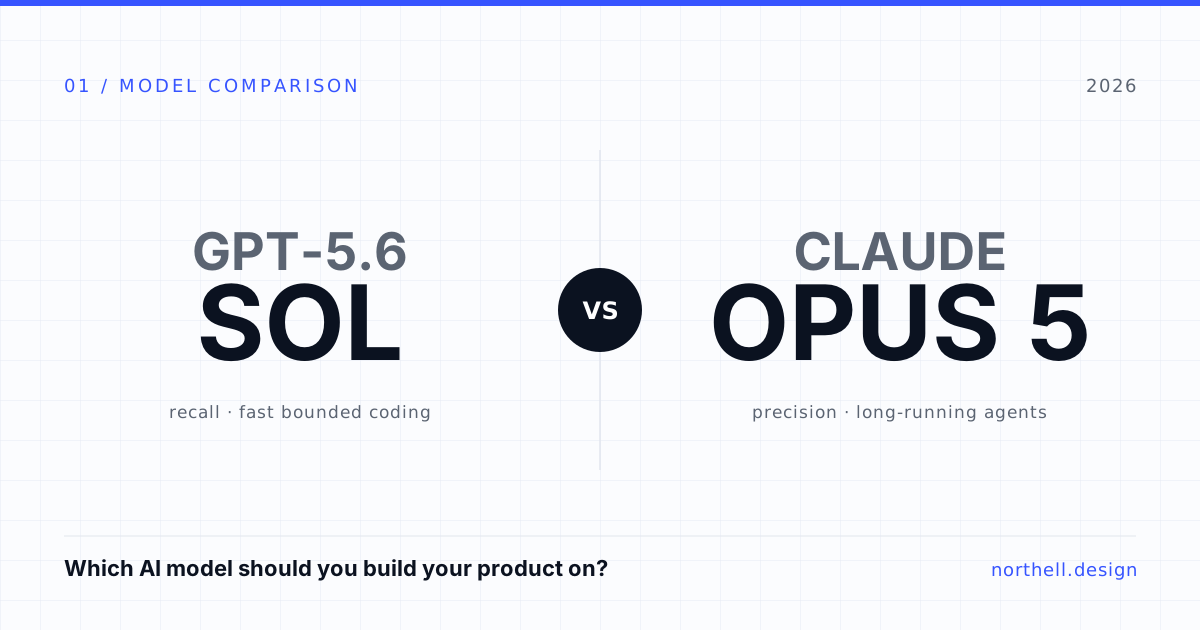
For building production products in 2026, pick GPT-5.6 Sol when you want broad issue recall and fast, bounded agentic coding at a lighter token cost, and pick Claude Opus 5 when precision, self-verification, and long-running agents matter more than raw speed. Neither wins outright. The right choice follows your workload.
Both models are frontier-class, and they are priced within striking distance of each other: Opus 5 at $5 per million input tokens and $25 output, Sol at $5 and $30, per Anthropic's Opus 5 announcement (24 July 2026) and the Eden AI GPT-5.6 Sol guide (August 2026). So the interesting question is not which one benchmarks higher. It is which one survives contact with your production workload and your cost model. This article works through agentic coding, debugging behaviour, cost per real task, and long-running agents, then gives you a decision framework you can apply the same afternoon.
Meet the two models: what actually shipped
Claude Opus 5 was released by Anthropic on 24 July 2026. Anthropic positions it as thoughtful and proactive, with self-verification and a step change for long-running agents and computer use. It keeps the Opus price point of $5 input and $25 output per million tokens.
GPT-5.6 Sol was announced on 26 June 2026 as a limited preview and is the flagship of the GPT-5.6 family, which reached general availability in July 2026. Family context matters here: Sol is the top tier, not the cheap one. Below it sit Terra at $2.50 and $15, and Luna at $1 and $6 per million tokens, and a compute-heavy Sol Ultra mode runs the same model harder, per Eden AI (August 2026). Knowing the family exists changes the cost conversation later, because Sol is often more model than a given task needs.
| GPT-5.6 Sol | Claude Opus 5 | |
|---|---|---|
| Released | 26 Jun 2026 (preview); family GA Jul 2026 | 24 Jul 2026 |
| Input / output per 1M tokens | $5.00 / $30.00 | $5.00 / $25.00 |
| Cheaper same-family tiers | Terra $2.50/$15, Luna $1/$6 | Single Opus tier |
| Headline agentic benchmark | Terminal-Bench 2.1: 88.8% (Sol Ultra 91.9%) | SWE-bench Verified 96.0%; OSWorld 2.0 70.57% |
| Behaviour under review | Recall-oriented: surfaces more, less often right | Precision-oriented: self-checks, iterates on root cause |
| Best-fit workload | Fast, bounded agentic coding; high-recall review | Long-running agents, computer use, precision-critical work |
Key takeaway: the two vendors report different headline benchmarks, so the spec sheet already tells you these models are tuned for different jobs before you run a single test.
Agentic coding: which one writes and ships better code?
Is GPT-5.6 Sol or Claude Opus 5 better for agentic coding?
Agentic coding means the model works in a loop — reading files, running commands, checking output, and iterating — rather than emitting one block of code and stopping. On the benchmark Sol reports, Terminal-Bench 2.1, it scores 88.8%, rising to 91.9% in Sol Ultra mode, edging GPT-5.5 and Claude's mid-tier at 88.0%, per Eden AI (August 2026). That is a strong result on autonomous terminal work.
Opus 5 leads with different numbers. Anthropic reports 96.0% on SWE-bench Verified and frames its coding gains against Frontier-Bench v0.1 and CursorBench 3.2, where at maximum effort it lands within 0.5% of the top score at roughly half the cost per task (Anthropic, 24 July 2026). The catch is that the two labs almost never report the same benchmark, so a clean apples-to-apples number is scarce. That scarcity is itself the insight: any table showing both models on one axis is usually stitching together different tests, harnesses, and versions.
It helps to know what each test actually measures. Terminal-Bench scores a model driving a real terminal to finish tasks end to end, which rewards autonomous tool use and recovery. SWE-bench Verified scores whether a model resolves a real GitHub issue with a patch that passes the project's own tests, which rewards correct, mergeable fixes. Both are legitimate signals of coding ability, but they reward different behaviours, so a lead on one does not transfer cleanly to the other.
The practical read is consistent across the data. Sol leans toward broad recall — it catches more and moves fast on bounded tasks. Opus 5 leans toward precision and careful iteration. For a well-scoped feature with a clear finish line, Sol is extremely competitive and often quicker. For work where the code touches something expensive to get wrong, Opus 5's care starts to pay for itself. If your open question is narrower — which assistant your engineers should standardise on day to day — the Claude vs. Codex comparison covers that directly.
Debugging and self-verification: how each behaves when it is wrong
How do GPT-5.6 Sol and Opus 5 compare on debugging and self-verification?
This is where production teams get burned, because the failure mode that hurts is not a model that says "I do not know." It is a model that returns a plausible, confident, wrong fix. Opus 5's headline differentiator is self-verification: it checks its own work and iterates on root-cause debugging rather than stopping at the first answer that looks right.
The clearest public data on this split comes from CodeRabbit's code-review evaluation (2026). Running Opus 5 at x-high effort, they measured about 39.3% actionable precision — the share of its comments worth keeping — against a baseline of 35.2%, but it caught fewer known issues at 55.2% coverage. GPT-5.6 Sol ran the other way: about 69.7% coverage of known issues, but only 31.6% precision. In plain terms, Sol surfaces more and leans on you to filter the noise; Opus 5 says less and is more often right about what matters.
A concrete version of this shows up in everyday work. Ask both models to fix a failing test caused by a race condition. A recall-oriented model will often return a change that makes the test pass by widening a timeout — plausible, green, and wrong about the cause. A self-verifying model is likelier to trace the shared state, name the actual race, and fix it, at the cost of more reasoning tokens spent getting there. Which behaviour you want depends entirely on what a wrong-but-green result costs you downstream.
That precision is not free. In the same evaluation, Opus 5 read about 50% more input tokens and wrote about 65% more output per call — roughly 60.5k input and 9.5k output tokens against Sol's 40.5k and 5.8k. Self-verification costs tokens, and that number flows straight into the cost section below. CodeRabbit's own conclusion is worth repeating: Opus 5 is a strong precision-oriented lane inside a routed ensemble, not an automatic single reviewer for every change. The honest guidance is to weight self-verification heavily when a wrong answer is expensive — fintech, healthtech, anything touching money or records — and to weight recall when the cost of a miss is a human catching it later.
Working on something like this? See our Claude Agent Development →
Cost per task, not cost per token: the number that actually matters
Which model is cheaper to run in production?
Sticker price is close, so it is close to useless on its own. The real cost of a model is the tokens it consumes per completed task, multiplied by how often it has to retry. A model that self-verifies and gets it right once can beat a nominally cheaper model that needs three passes — and a model that burns 50% more tokens per call can erase its own precision advantage on high volume.
Take a mid-sized feature handling 50,000 requests a month. First, the naive view, assuming both models draw the same tokens per call — about 8,000 input and 1,500 output, or 400M input and 75M output monthly.
| Model | Input cost | Output cost | Monthly total |
|---|---|---|---|
| GPT-5.6 Sol | $2,000 | $2,250 | $4,250 |
| Claude Opus 5 | $2,000 | $1,875 | $3,875 |
On equal tokens, Opus 5 is actually the cheaper of the two, because its output rate is lower. But equal tokens is a fiction. Apply the token appetite CodeRabbit measured — Opus 5 drawing roughly 50% more input and 65% more output on the same work — and the picture flips.
| Model | Input cost | Output cost | Monthly total |
|---|---|---|---|
| GPT-5.6 Sol | $2,000 | $2,250 | $4,250 |
| Claude Opus 5 (heavier draw) | $3,000 | $3,094 | $6,094 |
Now Opus 5 costs about 43% more for the same task volume. Neither table is "the" answer. Your real number sits between them and depends on two things you can measure: how many tokens each model actually draws on your prompts, and how often each has to retry to reach a correct result. If Opus 5's self-verification cuts your retry rate enough, the heavier per-call draw can still come out ahead on cost per completed task. If it does not, Sol wins on price at scale — and if Sol is more model than the task needs, the cheaper Terra and Luna tiers are the real lever. Whichever way it lands, this guide to reducing Claude API token costs covers the settings that move this number regardless of model.
Key takeaway: cost is a property of your traffic shape, not of the model. Twenty minutes with your own token counts beats any published price comparison.
Long-running agents and computer use: which holds up over hundreds of steps?
Which model is better for long-running agents and computer use?
For one-shot completions, a single benchmark tells you most of what you need. For agent products that run a tool-calling loop across dozens or hundreds of steps, stability over the whole run matters far more than any single score, because small per-step error rates compound.
This is the axis Anthropic built Opus 5 around. It reports 70.57% on OSWorld 2.0, a computer-use benchmark where the model operates a real screen, against 55.7% for the model it replaces, and says it outperforms other models at any given cost on that test. On Zapier AutomationBench, which checks whether a model can drive a full automation workflow to completion, Anthropic reports Opus 5 at roughly 1.5x the next-best model's pass rate at the same cost per task (Anthropic, 24 July 2026). These are vendor-reported numbers, so treat them as a strong signal rather than a settled fact — but they point the same direction as the self-verification data.
Sol deserves its due here too: its Terminal-Bench lead is exactly the kind of bounded, fast agentic work where it shines. The guidance splits cleanly. For multi-hour autonomous agents and computer-use flows, Opus 5 is the safer default today. For fast, bounded agentic coding tasks inside a tighter loop, Sol is highly competitive and often cheaper. If you are designing multi-step automation, this write-up on multi-agent AI workflows covers the orchestration patterns that decide reliability more than the model choice does.
How to choose: a decision framework
Since the scoreboard is unusable across vendors, here is the sequence to run instead. It fits in an afternoon and it does not depend on a leaderboard.
1. Name the workload. Is it a bounded coding task, a high-volume review or classification job, or a long autonomous agent? This alone narrows the field.
2. Set your cost ceiling per task and your volume. A few hundred calls a day and a few million tolerate a token-hungry model; tens of millions do not.
3. Price a wrong answer in your domain. In fintech or health, a confident-but-wrong output is expensive, so weight precision and self-verification. Elsewhere, recall plus a human reviewer may be cheaper overall.
4. Check your latency budget. Heavier reasoning and larger token draws cost wall-clock time as well as money.
Turn those into rules you can act on:
- Bounded, fast agentic coding with a clear finish line — pick GPT-5.6 Sol.
- Precision-critical debugging where a wrong fix is costly — pick Claude Opus 5.
- Long-running autonomous agents or computer use — pick Claude Opus 5.
- High-volume, cost-sensitive review where a human filters output — pick GPT-5.6 Sol, or a cheaper Terra or Luna tier.
- Unsure, or the workload is mixed — run both against 30 of your own real tasks before committing.
Should I switch my product from an older model to one of these?
Only if a measured evaluation on your own tasks shows a real gain in accuracy, cost per task, or latency. Pull 30 representative inputs from your product, grade both models against them, and let the result decide. That artifact describes your workload better than any benchmark and keeps working when the next model ships.
Can I use both models in the same product?
Yes, and it is often the strongest answer. Route high-volume or low-stakes calls to a cheaper model, precision-critical steps to Opus 5, and fast agentic coding to Sol. Choosing the model is the easy 20% of this work. The hard 80% is the evaluation harness, the guardrails, and the monitoring around it — which is exactly where teams that ship and operate AI in production spend their time, and where our AI development practice does most of its work.
Build vs. bet: why the model is the smallest decision you will make
Whichever model wins for you today will be superseded within months. Anthropic moved from Opus 4.8 to Opus 5 in a single cycle; OpenAI went from 5.5 to the 5.6 family in roughly the same window. Betting your architecture on one model ID means re-platforming every quarter.
The durable engineering decision is to treat the model as a swappable component. That means an evaluation suite that runs against whatever sits behind the interface, prompt and version control, an abstraction layer between your product and the provider, and monitoring that tells you when quality drifts. Teams that build this way switch models in an afternoon when a better or cheaper one lands. Teams that hard-code a provider pay for a migration they did not plan. It is a modest amount of extra work up front, and across our AI development and custom software engagements it has repeatedly saved a rewrite. Building an AI feature and not sure which model to bet on? Talk to Northell's engineering team.
So which one should you pick?
The honest answer is that it depends on the workload, and now that dependency is concrete. GPT-5.6 Sol is the pick for broad recall and fast, bounded agentic coding, at a lighter token profile that keeps high-volume costs down. Claude Opus 5 is the pick for precision, self-verification, and long-running agents and computer use, at a token-hungry but higher-confidence profile that earns its keep when a wrong answer is expensive.
Both are closed-weight APIs priced within striking distance, so the decision rarely comes down to the rate card. It comes down to what your product does when the model is wrong, how many tokens it draws on your prompts, and how long its agent loops run. Pick for that, price it against your own traffic, and wrap it in an architecture you can swap. For a wider view across three flagships, the Claude Opus 5 vs. GPT-5.5 vs. Gemini 3.1 Pro comparison covers the benchmarks that are genuinely comparable and the many that are not. All figures here are dated to August 2026 and worth re-checking at your decision point, because this space moves monthly.